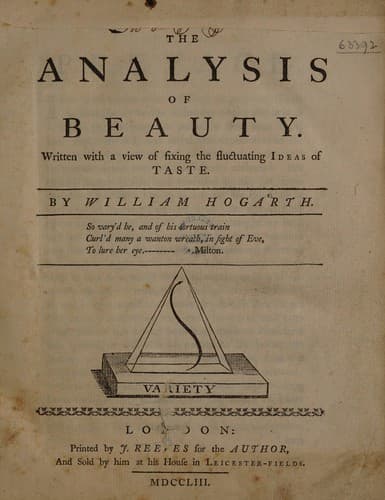
The Analysis of Beauty: Written with a view of fixing the fluctuating ideas of tasteHogarth, William
Philosophy
The Analysis of Beauty: Written with a view of fixing the fluctuating ideas of taste
Hogarth, William
Aesthetics -- Early works to 1800
The general idea of an action, as well as of an attitude, may be given
with a pencil in very few lines. It is easy to conceive that the
attitude of a person upon the cross, may be fully signified by the two
straight lines of the cross; so the extended manner of St. Andrew's
crucifixion is wholly understood by the X-like cross.
Thus, as two or three lines at first are sufficient to shew the
intention of an attitude, I will take this opportunity of presenting
my reader (who may have been at the trouble of following me thus far)
with the sketch of a country-dance, in the manner I began to set out
the design; in order to shew how few lines are necessary to express the
first thoughts, as to different attitudes; see fig. [71 T p. II], which
describe in some measure, the several figures and actions, mostly of
the ridiculous kind, that are represented in the chief part of plate II.
[Illustration: Fig. 71]
The most amiable person may deform his general appearance by throwing
his body and limbs into plain lines, but such lines appear still in
a more disagreeable light in people of a particular make, I have
therefore chose such figures as I thought would agree best with my
first score of lines, fig. 71.
[Illustration: The dancers]
The two parts of curves next to 71, served for the figures of the old
woman and her partner at the farther end of the room. The curve and
two straight lines at right angles, gave the hint for the fat man's
sprawling posture. I next resolved to keep a figure within the bounds
of a circle, which produced the upper part of the fat woman, between
the fat man and the aukward one in the bag wig, for whom I had made
a sort of an X. The prim lady, his partner, in the riding-habit, by
pecking back her elbows, as they call it, from the waste upwards, made
a tolerable D, with a straight line under it, to signify the scanty
stiffness of her peticoat; and a Z stood for the angular position the
body makes with the legs and thighs of the affected fellow in the
tye-wig; the upper part of his plump partner was confin'd to an O, and
this chang'd into a P, served as a hint for the straight lines behind.
The uniform diamond of a card, was filled up by the flying dress, &c.
of the little capering figure in the spencer-wig; whilst a double L
mark'd the parallel position of his poking partner's hands and arms:
and lastly, the two waving lines were drawn for the more genteel turns
of the two figures at the hither end.
The best representation in a picture, of even the most elegant dancing,
as every figure is rather a suspended action in it than an attitude,
must be always somewhat unnatural and ridiculous; for were it possible
in a real dance to fix every person at one instant of time, as in a
picture, not one in twenty would appear to be graceful, tho' each were
ever so much so in their movements; nor could the figure of the dance
itself be at all understood.
[Illustration: The statues and pictures]
Public-domain text, read in full here on John Shaqi.
Reviews
Reviews
No reviews yet
Be the first to share your thoughts on this work.
Elsewhere in the archive
Join the Discussion
Join the discussion
Sign in to leave a comment or review.
Sign InorCreate an account