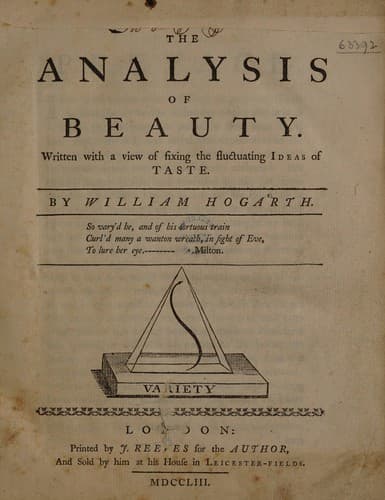
The Analysis of Beauty: Written with a view of fixing the fluctuating ideas of tasteHogarth, William
Philosophy
The Analysis of Beauty: Written with a view of fixing the fluctuating ideas of taste
Hogarth, William
Aesthetics -- Early works to 1800
By these obvious appearances, and the differences of the whole size,
we easily judge of ages till twenty, but not with such certainty
afterwards; for the alterations from that age are of a different kind,
subject to other changes by growing fatter or leaner, which it is well
known, often give a different turn to the look of the person, with
regard to his age.
The hair of the head, which encompasses a face as a frame doth a
picture, and contrasts with its uniform colour, the variegated inclosed
composition, adding more or less beauty thereto, according as it is
disposed by the rules of art, is another indication of advanced age.
What remains to be said on the different appearances of ages, being
less pleasing than what has gone before, shall be described with more
brevity. In the age from twenty to thirty, barring accidents, there
appears but little change, either in the colours or the lines of the
face; for tho' the bloom tints may go off a little, yet on the other
hand, the make of the features often attain a sort of settled firmness
in them, aided by an air of acquired sensibility; which makes ample
amends for that loss, and keeps beauty till thirty pretty much upon a
par; after this time, as the alterations grow more and more visible,
we perceive the sweet simplicity of many rounding parts of the face,
begin to break into dented shapes, with more sudden turns about the
muscles, occasioned by their many repeated movements; as also by
dividing the broad parts, and thereby taking off the large sweeps of
the serpentine lines; the shades of beauty also consequently suffering
in their softnesses. Something of what is here meant between the two
ages of thirty and fifty, see in figures [117 and 118 B p. II], and
what further havock time continues to make after the age of fifty, is
too remarkable to need describing: the strokes and cuts he then lays on
are plain enough; however, in spite of all his malice, those lineaments
that have once been elegant, retain their flowing turns in venerable
age, leaving to the last a comely piece of ruins.
[Illustration: Figs. 117 and 118]
CHAPTER XVI.
_Of ATTITUDE_.
Such dispositions of the body and limbs as appear most graceful when
seen at rest, depend upon gentle winding contrasts, mostly govern'd
by the precise serpentine line, which in attitudes of authority, are
more extended and spreading than ordinary, but reduced somewhat below
the medium of grace, in those of negligence and ease: and as much
exaggerated in insolent and proud carriage, or in distortions of pain
(see figure 9, plate I) as lessen'd and contracted into plain and
parallel lines, to express meanness, aukwardness, and submission.
[Illustration: Fig. 9]
Public-domain text, read in full here on John Shaqi.
Reviews
Reviews
No reviews yet
Be the first to share your thoughts on this work.
Elsewhere in the archive
Join the Discussion
Join the discussion
Sign in to leave a comment or review.
Sign InorCreate an account