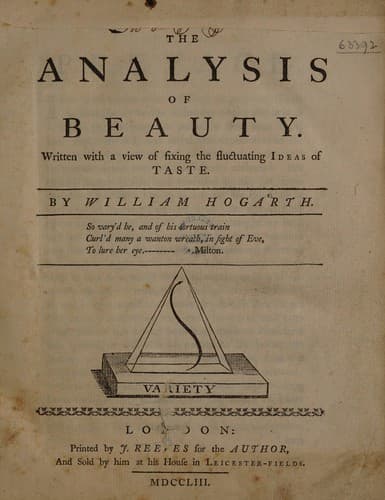
The Analysis of Beauty: Written with a view of fixing the fluctuating ideas of tasteHogarth, William
Philosophy
The Analysis of Beauty: Written with a view of fixing the fluctuating ideas of taste
Hogarth, William
Aesthetics -- Early works to 1800
Action is a sort of language which perhaps one time or other, may
come to be taught by a kind of grammar-rules; but, at present, is only
got by rote and imitation: and contrary to most other copyings or
imitations, people of rank and fortune generally excel their originals,
the dancing-masters, in easy behaviour and unaffected grace; as a sense
of superiority makes them act without constraint; especially when their
persons are well turn'd. If so, what can be more conducive to that
freedom and necessary courage which make acquired grace seem easy and
natural, than the being able to demonstrate _when_ we are actually just
and proper in the least movement we perform; whereas, for want of such
certainty in the mind, if one of the most finish'd gentlemen at court
was to appear as an actor on the public stage, he would find himself
at a loss how to move properly, and be stiff, narrow, and aukward, in
representing even his own character: the uncertainty of being right
would naturally give him some of that restraint which the uneducated
common people generally have when they appear before their betters.
It is known that bodies in motion always describe some line or other
in the air, as the whirling round of a fire-brand apparently makes a
circle, the water-fall part of a curve, the arrow and bullet, by the
swiftness of their motions, nearly a straight line; waving lines are
formed by the pleasing movement of a ship on the waves. Now in order
to obtain a just idea of action at the same time to be judiciously
satisfied of being in the right in what we do, let us begin with
imagining a line formed in the air by any supposed point at the end
of a limb or part that is moved, or made by the whole part, or limb;
or by the whole body together. And that thus much of movements may be
conceived at once is evident, on the least recollection, for whoever
has seen a fine arabian war-horse, unback'd and at liberty, and in a
wanton trot, cannot but remember what a large waving line his rising,
and at the same time pressing forward, cuts through the air; the equal
continuation of which, is varied by his curveting from side to side;
whilst his long mane and tail play about in serpentine movements.
After thus having form'd the idea of all movements being as lines, it
will not be difficult to conceive, that grace in action depends upon
the same principles as have been shewn to produce it in forms.
The next thing that offers itself to our consideration is the force of
_habit_ and custom in action; for a great deal depends thereon.
The peculiar movements of each person, as the gate in walking, are
particularised in such lines as each part describes by the habits they
have contracted. The nature and power of habit may be fully conceived
by the following familiar instance, as the motions of one part of the
body may serve to explain those of the whole.
Public-domain text, read in full here on John Shaqi.
Reviews
Reviews
No reviews yet
Be the first to share your thoughts on this work.
Elsewhere in the archive
Join the Discussion
Join the discussion
Sign in to leave a comment or review.
Sign InorCreate an account