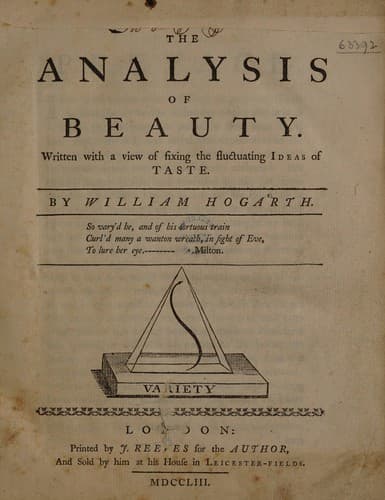
The Analysis of Beauty: Written with a view of fixing the fluctuating ideas of tasteHogarth, William
Philosophy
The Analysis of Beauty: Written with a view of fixing the fluctuating ideas of taste
Hogarth, William
Aesthetics -- Early works to 1800
Observe that whatever habit the fingers get in the use of the pen,
you see exactly delineated to the eye by the shapes of the letters.
Were the movements of every writer's fingers to be precisely the same,
one hand-writing would not be known from another, but as the fingers
naturally fall into, or acquire different habits of moving, every
hand-writing is visibly different. Which movements must tally with
the letters, tho' they are too quick and too small to be as perfectly
traced by the eye; but this shews what nice differences are caused, and
constantly retained by habitual movements.
It may be remark'd, that all useful habitual motions, such as are
readiest to serve the necessary purposes of life, are those made up of
plain lines, i. e. straight and circular lines, which most animals have
in common with mankind, tho' not in so extensive a degree: the monkey
from his make hath it sufficiently in his power to be graceful, but as
reason is required for this purpose, it would be impossible to bring
him to move genteelly.
Though I have said that the ordinary actions of the body are performed
in plain lines, I mean only comparatively so with those of studied
movements in the serpentine line, for as all our muscles are ever ready
to act, when one part is moved, (as an hand, or arm, by its proper
movers, for raising up or drawing down) the adjacent muscles act in
some degree in correspondence with them: therefore our most common
movements are but seldom performed in such absolutely mean lines, as
those of jointed dolls and puppets. A man must have a good deal of
practice to be able to mimic such very straight or round motions, which
being incompatible with the human form, are therefore ridiculous.
Let it be observed, that graceful movements in serpentine lines,
are used but occasionally, and rather at times of leisure, than
constantly applied to every action we make. The whole business of life
may be carried on without them, they being properly speaking, only
the ornamental part of gesture; and therefore not being naturally
familiarised by necessity, must be acquired by precept or imitation,
and reduced to habit by frequent repetitions. _Precept_ is the means I
should recommend as the most expeditious and effectual way. But before
we proceed to the method I have to propose, for the more ready and sure
way of accustoming the limbs to a facility in the ornamental way of
moving; I should observe, that quick time gives it spirit and vivacity,
as slow time, gravity, and solemnity, and further, that the latter of
these allows the eye an opportunity of seeing the line of grace to
advantage, as in the address of heroes on the stage, or in any solemn
act of ceremony; and that although time in movement is reduced to
certain rules for dancing, it is left more at large and at discretion
for deportment.
We come now to offer an odd, but perhaps efficacious method of
acquiring a habit of moving in the lines of grace and beauty.
Public-domain text, read in full here on John Shaqi.
Reviews
Reviews
No reviews yet
Be the first to share your thoughts on this work.
Elsewhere in the archive
Join the Discussion
Join the discussion
Sign in to leave a comment or review.
Sign InorCreate an account