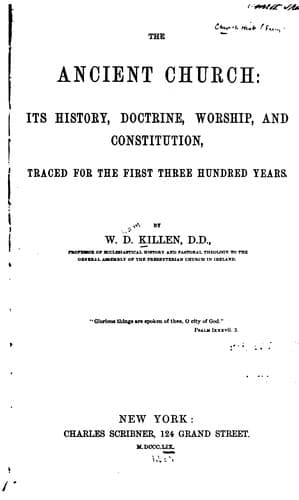
The Ancient Church: Its History, Doctrine, Worship, and ConstitutionKillen, W. D. (William Dool)
Religion
The Ancient Church: Its History, Doctrine, Worship, and Constitution
Killen, W. D. (William Dool)
Church history -- Primitive and early church, ca. 30-600
When Paul was at Corinth, and probably in A.D. 53, he wrote his two
earliest letters, that is, the First and Second Epistles to the
Thessalonians. These communications must, therefore, have been drawn up
about twelve months after the original formation of the religious
community to which they are addressed. The Thessalonian Church was
already fully organised, as the apostle here points out to the disciples
their duties to those who laboured among them and who were over them in
the Lord. [113:3] In the meantime several errors had gained currency;
and a letter, announcing that the day of Christ was at hand, and
purporting to have been penned by Paul himself, had thrown the brethren
into great consternation. [113:4] The apostle accordingly deemed it
necessary to interpose, and to point out the dangerous character of the
doctrines which had been so industriously promulgated. He now, too,
delivered his famous prophecy announcing the revelation of the "Man of
Sin" before the second coming of the Redeemer. [113:5] Almost all the
members of the Thessalonian Church were probably converted Gentiles,
[113:6] who must still have been but little acquainted with the Jewish
Scriptures; and this is perhaps the reason why there is no quotation
from the Old Testament in either of these letters. Even the Gospels do
not seem to have been yet written, and hence Paul exhorts the brethren
"to hold fast the traditions," or rather "ordinances," [114:1] which
they had been taught, "whether by word or his epistle." [114:2]
CHAPTER VIII.
THE CONVERSION OF APOLLOS, HIS CHARACTER, AND THE
MINISTRY OF PAUL IN EPHESUS.
A.D. 54 TO A.D. 57.
The Apostle "took his leave" [115:1] of the Corinthian brethren in the
spring of A.D. 54, and embarking at the port of Cenchrea, about eight or
nine miles distant, set sail for Ephesus. The navigation among the
islands of the Greek Archipelago was somewhat intricate; and the voyage
appears to have not unfrequently occupied from ten to fifteen days.
[115:2] At Ephesus Paul "entered into the synagogue, and reasoned with
the Jews." [115:3] His statements produced a favourable impression, and
he was solicited to prolong his visit; but as he was on his way to
Jerusalem, where he was anxious to be present at the approaching feast
of Pentecost, he could only assure them of his intention to return, and
then bid them farewell. He left behind him, however, in this great city
his two Corinthian converts, Aquila and Priscilla, who carried on with
industry and success the work which he had commenced so auspiciously.
Among the first fruits of their pious care for the spread of
Christianity was the famous Apollos, an Alexandrian Jew, who now arrived
in the metropolis of the Proconsular Asia.
Public-domain text, read in full here on John Shaqi.
Reviews
Reviews
No reviews yet
Be the first to share your thoughts on this work.
Elsewhere in the archive
Join the Discussion
Join the discussion
Sign in to leave a comment or review.
Sign InorCreate an account