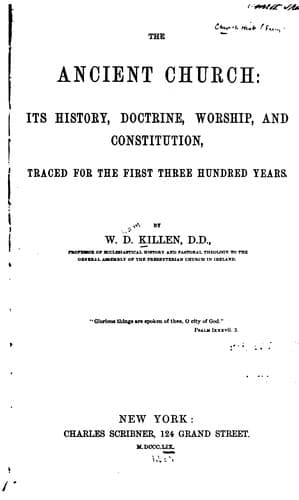
The Ancient Church: Its History, Doctrine, Worship, and ConstitutionKillen, W. D. (William Dool)
Religion
The Ancient Church: Its History, Doctrine, Worship, and Constitution
Killen, W. D. (William Dool)
Church history -- Primitive and early church, ca. 30-600
The seed of Abraham in the birthplace of Apollos spoke the Greek
language, and were in somewhat peculiar circumstances. They were free
from some of the prejudices of the Jews in Palestine; and, though living
in the midst of a heathen population, had advantages which were enjoyed
by very few of their brethren scattered elsewhere among the Gentiles. At
Alexandria their sumptuous synagogues were unequivocal evidences of
their wealth; they constituted a large and influential section of the
inhabitants; they had much political power; and, whilst their study of
the Greek philosophy had modified their habits of thought, they had
acquired a taste for the cultivation of eloquence and literature.
Apollos, the Jew "born at Alexandria," [116:1] who now became acquainted
with Aquila and Priscilla, was an educated and accomplished man. It is
said that "he was instructed in the way of the Lord, and being fervent
in the spirit, he spake and taught diligently the things of the Lord,
knowing only the baptism of John." [116:2] The influence of the
preaching of the Baptist may be estimated from this incidental notice;
for though the forerunner of our Saviour had now finished his career
about a quarter of a century, the Alexandrian Jew was only one of many
still living witnesses to testify that he had not ministered in vain. In
this case John had indeed "prepared the way" of his Master, as, under
the tuition of Aquila and Priscilla, Apollos was led without difficulty
to embrace the Christian doctrine. It is said of this pious couple that
"they took him unto them, and expounded unto him the way of God more
perfectly." [116:3] Priscilla was no less distinguished than her husband
[116:4] for intelligence and zeal; and though she was prevented, as
much, perhaps, by her native modesty, as by the constitution of the
Church, [116:5] from officiating as a public instructor, she was, no
doubt, "apt to teach;" and there must have been something most
interesting and impressive in her private conversation. It is a
remarkable fact that one of the ablest preachers of the apostolic age
was largely indebted to a female for his acquaintance with Christian
theology.
Public-domain text, read in full here on John Shaqi.
Reviews
Reviews
No reviews yet
Be the first to share your thoughts on this work.
Elsewhere in the archive
Join the Discussion
Join the discussion
Sign in to leave a comment or review.
Sign InorCreate an account