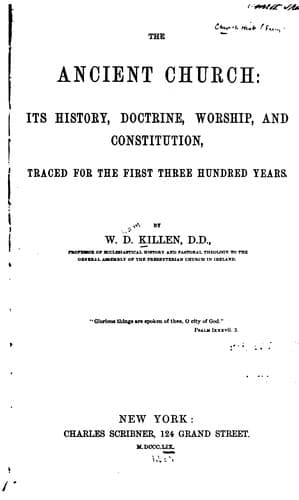
The Ancient Church: Its History, Doctrine, Worship, and ConstitutionKillen, W. D. (William Dool)
Religion
The Ancient Church: Its History, Doctrine, Worship, and Constitution
Killen, W. D. (William Dool)
Church history -- Primitive and early church, ca. 30-600
Paul, about two years before, had been prevented, as has been stated, by
a divine intimation, from preaching in the district called Asia; but
when he now commenced his ministrations in Ephesus, its capital, he
continued in that city and its neighbourhood longer than in any other
place he had yet visited. After withdrawing from the synagogue and
resuming his labours in the school of Tyrannus, he remained there "by
the space of _two years_; so that all they which dwelt in Asia heard the
word of the Lord Jesus, both Jews and Greeks." [121:1] Meanwhile the
churches of Laodicea, Colosse, and Hierapolis appear to have been
founded. [121:2] The importance of Ephesus gave it a special claim to
the attention which it now received. It was the metropolis of the
district, and the greatest commercial city in the whole of Asia Minor.
Whilst it was connected by convenient roads with all parts of the
interior, it was visited by trading vessels from the various harbours of
the Mediterranean. But, in another point of view, it was a peculiarly
interesting field of missionary labour; for it was, perhaps, the most
celebrated of all the high places of Eastern superstition. Its temple of
Artemis, or Diana, was one of the wonders of the world. This gorgeous
structure, covering an area of upwards of two acres, [121:3] was
ornamented with columns one hundred and twenty-seven in number, each
sixty feet high, and each the gift of a king. [121:4] It was nearly all
open to the sky, but that part of it which was covered, was roofed with
cedar. The image of the goddess occupied a comparatively small apartment
within the magnificent enclosure. This image, which was said to have
fallen down from Jupiter, [121:5] was not like one of those pieces of
beautiful sculpture which adorned the Acropolis of Athens, but rather
resembled an Indian idol, being an unsightly female form with many
breasts, made of wood, and terminating below in a shapeless block.
[122:1] On several parts of it were engraved mysterious symbols, called
"Ephesian letters." [122:2] These letters, when _pronounced_, were
believed to operate as charms, and, when _written_, were carried about
as amulets. To those who sought an acquaintance with the Ephesian magic,
they constituted an elaborate study, and many books were composed to
expound their significance, and point out their application.
Public-domain text, read in full here on John Shaqi.
Reviews
Reviews
No reviews yet
Be the first to share your thoughts on this work.
Elsewhere in the archive
Join the Discussion
Join the discussion
Sign in to leave a comment or review.
Sign InorCreate an account