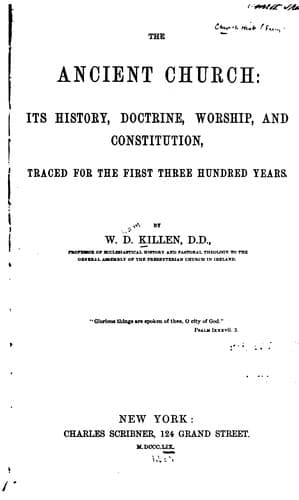
The Ancient Church: Its History, Doctrine, Worship, and ConstitutionKillen, W. D. (William Dool)
Religion
The Ancient Church: Its History, Doctrine, Worship, and Constitution
Killen, W. D. (William Dool)
Church history -- Primitive and early church, ca. 30-600
About this time the famous Apollonius of Tyana [122:3] was attracting
uncommon attention by his tricks as a conjuror; and it has been thought
not improbable that he now met Paul in Ephesus. If so, we can assign at
least one reason why the apostle was prevented from making his
appearance at an earlier date in the Asiatic metropolis. Men had thus an
opportunity of comparing the wonders of the greatest of magicians with
the miracles of the gospel; and of marking the contrast between the
vainglory of an impostor, and the humility of a servant of Jesus. The
attentive reader of Scripture may observe that some of the most
extraordinary of the mighty works recorded in the New Testament were
performed at this period; and it is not unreasonable to conclude that,
in a city so much given to jugglery and superstition, these genuine
displays of the power of Omnipotence were exhibited for the express
purpose of demonstrating the incomparable superiority of the Author of
Christianity. It is said that "God wrought _special miracles_ by the
hands of Paul, so that from his body were brought unto the sick
handkerchiefs or aprons, and the diseases departed from them, and the
evil spirits went out of them." [123:1] The disastrous consequences of
an attempt, on the part of the sons of a Jewish priest, to heal the
afflicted by using the name of the Lord Jesus as a charm, alarmed the
entire tribe of exorcists and magicians. "The man, in whom the evil
spirit was, leaped on them, and overcame them, and prevailed against
them, so that they fled out of that house naked and wounded. And this
was known to all the Jews and Greeks also dwelling at Ephesus, and _fear
fell on them all_, and the name of the Lord Jesus was magnified."
[123:2] The visit of Paul told upon the whole population, and tended
greatly to discourage the study of the "Ephesian letters". "Many of them
also which used curious arts brought their books together and burned
them before all men; and they counted the price of them, and found it
fifty thousand pieces of silver. [123:3] So mightily grew the word of
God and prevailed." [123:4]
Public-domain text, read in full here on John Shaqi.
Reviews
Reviews
No reviews yet
Be the first to share your thoughts on this work.
Elsewhere in the archive
Join the Discussion
Join the discussion
Sign in to leave a comment or review.
Sign InorCreate an account