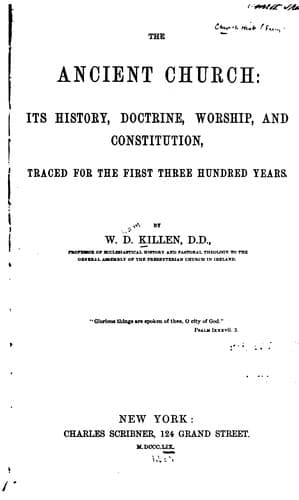
The Ancient Church: Its History, Doctrine, Worship, and ConstitutionKillen, W. D. (William Dool)
Religion
The Ancient Church: Its History, Doctrine, Worship, and Constitution
Killen, W. D. (William Dool)
Church history -- Primitive and early church, ca. 30-600
support the credit of their tutelary guardian. They were "full of wrath,
and cried out saying--Great is Diana of the Ephesians." [125:2] This
proceeding seems to have taken place in the month of May, and at a time
when public games were celebrated in honour of the Ephesian goddess,
[125:3] so that a large concourse of strangers now thronged the
metropolis. An immense crowd rapidly collected; the whole city was
filled with confusion; and it soon appeared that the lives of the
Christian preachers were in danger; for the mob caught "Gaius and
Aristech's, men of Macedonia, Paul's companions in travel," and "rushed
with one accord into the theatre." [125:4] This edifice, the largest of
the kind in Asia Minor, is said to have been capable of containing
thirty thousand persons. [125:5] As it was sufficiently capacious to
accommodate the multitudinous assemblage, and as it was also the
building in which public meetings of the citizens were usually convened,
it was now quickly occupied. Paul was at first prompted to enter it, and
to plead his cause before the excited throng; but some of the
magistrates, or, as they are called by the evangelist, "certain of the
_chief of Asia_, which were his friends, sent unto him, desiring him
that he would not adventure himself" into so perilous a position.
[125:6] These _Asiarchs_ were persons of exalted rank who presided at
the celebration of the public spectacles. The apostle was now in very
humble circumstances, for even in Ephesus he continued to work at the
occupation of a tent-maker; [126:1] and it is no mean testimony to his
worth that he had secured the esteem of such high functionaries. It was
quickly manifest that any attempt to appease the crowd would have been
utterly in vain. A Jew, named Alexander, who seems to have been one of
the craftsmen, and who was, perhaps, the same who is elsewhere
distinguished as "the coppersmith," [126:2] made an effort to address
them, probably with the view of shewing that his co-religionists were
not identified with Paul; but when the mob perceived that he was one of
the seed of Abraham, they took it for granted that he was no friend to
the manufacture of their silver shrines; and his appearance was the
signal for increased uproar. "When they knew that he was a Jew, all with
one voice, _about the space of two hours_, cried out--Great is Diana of
the Ephesians." [126:3] At length the town-clerk, or recorder, of
Ephesus, contrived to obtain a hearing; and, by his prudence and
address, succeeded in putting an end to this scene of confusion. He told
his fellow-townsmen that, if Paul and his companions had transgressed
the law, they could be made amenable to punishment; but that, as their
own attachment to the worship of Diana could not be disputed, their
present tumultuary proceedings could only injure their reputation as
orderly and loyal citizens. "We are in danger," said he, "to be called
in question for this day's uproar, there being no cause whereby we may
Public-domain text, read in full here on John Shaqi.
Reviews
Reviews
No reviews yet
Be the first to share your thoughts on this work.
Elsewhere in the archive
Join the Discussion
Join the discussion
Sign in to leave a comment or review.
Sign InorCreate an account