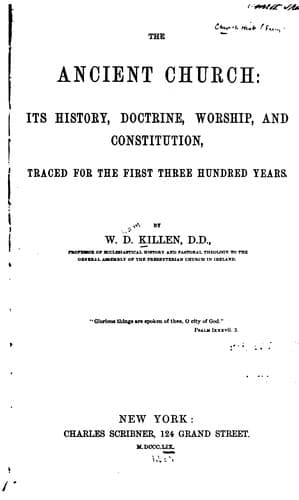
The Ancient Church: Its History, Doctrine, Worship, and ConstitutionKillen, W. D. (William Dool)
Religion
The Ancient Church: Its History, Doctrine, Worship, and Constitution
Killen, W. D. (William Dool)
Church history -- Primitive and early church, ca. 30-600
Some time before the departure of Paul from Ephesus, he wrote the First
Epistle to the Corinthians. The letter contains internal evidence that
it was dictated in the spring of A.D. 57. [123:5] The circumstances of
the Corinthian disciples at this juncture imperatively required the
interference of the apostle. Divisions had sprung up in their community;
[123:6] the flagrant conduct of one member had brought dishonour on the
whole Christian name; [123:7] and various forms of error had been making
their appearance. [123:8] Paul therefore felt it right to address to
them a lengthened and energetic remonstrance. This letter is more
diversified in its contents than any of his other epistles; and presents
us with a most interesting view of the daily life of the primitive
Christians in a great commercial city. It furnishes conclusive evidence
that the Apostolic Church of Corinth was not the paragon of excellence
which the ardent and unreflecting have often pictured in their
imaginations, but a community compassed with infirmities, and certainly
not elevated, in point of spiritual worth, above some of the more
healthy Christian congregations of the nineteenth century.
Shortly after this letter was transmitted to its destination, Ephesus
was thrown into a ferment by the riotous proceedings of certain parties
who had an interest in the maintenance of the pagan superstition. Among
those who derived a subsistence from the idolatry of its celebrated
temple were a class of workmen who "made silver shrines for Diana,"
[124:1] that is, who manufactured little models of the sanctuary and of
the image which it contained. These models were carried about by the
devotees of the goddess in processions, and set up, in private
dwellings, as household deities. [124:2] The impression produced by the
Christian missionaries in the Asiatic metropolis had affected the
traffic in such articles, and those who were engaged in it began to
apprehend that their trade would be ultimately ruined. An individual,
named Demetrius, who appears to have been a master-manufacturer, did not
find it difficult, under these circumstances, to collect a mob, and to
disturb the peace of the city. Calling together the operatives of his
own establishment, "with the workmen of like occupation," [124:3] he
said to them--"Sirs, ye know, that by this craft we have our wealth.
Moreover, ye see and know, that not alone at Ephesus, but almost
throughout all Asia, this Paul hath persuaded and turned away much
people, saying that they be no gods which are made with hands--so that
not only this our craft is in danger to be set at nought, but also that
the temple of the great goddess Diana should be despised, and her
magnificence should be destroyed, whom all Asia and the world
worshipped." [125:1] This address did not fail to produce the effect
contemplated. A strong current of indignation was turned against the
missionaries; and the craftsmen were convinced that they were bound to
Public-domain text, read in full here on John Shaqi.
Reviews
Reviews
No reviews yet
Be the first to share your thoughts on this work.
Elsewhere in the archive
Join the Discussion
Join the discussion
Sign in to leave a comment or review.
Sign InorCreate an account