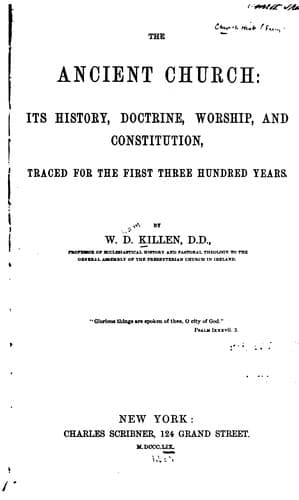
The Ancient Church: Its History, Doctrine, Worship, and ConstitutionKillen, W. D. (William Dool)
Religion
The Ancient Church: Its History, Doctrine, Worship, and Constitution
Killen, W. D. (William Dool)
Church history -- Primitive and early church, ca. 30-600
When the apostle and his companions reached the Jewish capital, "the
brethren received them gladly." [133:2] Paul was, however, given to
understand that, as he was charged with encouraging the neglect of the
Mosaic ceremonies, he must be prepared to meet a large amount of
prejudice; and he was accordingly recommended to endeavour to pacify the
multitude by giving some public proof that he himself "walked orderly
and kept the law." [133:3] Acting on this advice, he joined with four
men who had on them a Nazaritic vow; [133:4] and, "purifying himself
with them, entered into the temple." [133:5] When there, he was observed
by certain Jews from Asia Minor, who had probably become acquainted with
his personal appearance during his residence in Ephesus; and as they had
before seen him in the city with Trophimus, one of the seven deputies
and a convert from paganism, whom they seem also to have known, [134:1]
they immediately concluded that he had now some Gentile companions along
with him, and that he was encouraging the uncircumcised to pollute with
their presence the sacred court of the Israelites. A tumult forthwith
ensued; the report of the defilement of the holy place quickly
circulated through the crowd; "all the city was moved;" [134:2] the
people ran together; and Paul was seized and dragged out of the temple.
[134:3] The apostle would have fallen a victim to popular fury had it
not been for the prompt interference of the officer who had the command
of the Roman garrison in the tower of Antonia. This stronghold
overlooked the courts of the sanctuary; and, no doubt, some of the
sentinels on duty immediately gave notice of the commotion. The chief
captain, whose name was Claudius Lysias, [134:4] at once "took soldiers
and centurions," and running down to the rioters, arrived in time to
prevent a fatal termination of the affray; for, as soon as the military
made their appearance, the assailants "left beating of Paul." [134:5]
"Then the chief captain came near, and took him, and commanded him to be
bound with two chains, and demanded who he was, and what he had done.
And some cried one thing, some another, among the multitude, and when he
could not know the certainty for the tumult, he commanded him to be
carried into the castle." [134:6] In proceeding thus, the commanding
officer acted illegally; for, as Paul was a Roman citizen, he should
not, without a trial, have been deprived of his liberty, and put in
irons. But Lysias, in the hurry and confusion of the moment, had been
deceived by false information; as he had been led to believe that his
prisoner was an Egyptian, a notorious outlaw, who, "before these days,"
had created much alarm by leading "out into the wilderness four thousand
men that were murderers." [135:1] He was quite astonished to find that
the individual whom he had rescued from such imminent danger was a
citizen of Tarsus in Cilicia who could speak Greek; and as it was now
Public-domain text, read in full here on John Shaqi.
Reviews
Reviews
No reviews yet
Be the first to share your thoughts on this work.
Elsewhere in the archive
Join the Discussion
Join the discussion
Sign in to leave a comment or review.
Sign InorCreate an account