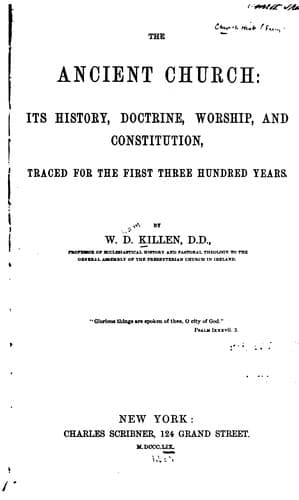
The Ancient Church: Its History, Doctrine, Worship, and ConstitutionKillen, W. D. (William Dool)
Religion
The Ancient Church: Its History, Doctrine, Worship, and Constitution
Killen, W. D. (William Dool)
Church history -- Primitive and early church, ca. 30-600
evident that there existed much misapprehension, the apostle was
permitted to stand on the stairs of the fortress, and address the
multitude. When they saw him preparing to make some statement, the noise
subsided; and, "when they heard that he spake to them in the Hebrew
tongue," that is, in the Aramaic, the current language of the country,
"they kept the more silence." [135:2] Paul accordingly proceeded to give
an account of his early life, of the remarkable circumstances of his
conversion, and of his subsequent career; but, when he mentioned his
mission to the Gentiles, it was at once apparent that the topic was most
unpopular, for his auditors lost all patience. "They gave him audience
unto this word, and then lifted up their voices and said, Away with such
a fellow from the earth, for it is not fit that he should live. And as
they cried out, and cast off their clothes, and threw dust into the air,
the chief captain commanded him to be brought into the castle." [135:3]
The confinement of Paul, which now commenced at the feast of Pentecost
in A.D. 58, continued about five years. It may be enough to notice the
mere outline of his history during this tedious bondage. In the first
place, for the purpose of ascertaining the exact nature of the charge
against him, he was confronted with the Sanhedrim; but when he informed
them that "of the hope and resurrection of the dead" he was called in
question, [136:1] there "arose a dissension between the Pharisees and
the Sadducees" [136:2] constituting the council; and the chief captain,
fearing lest his prisoner "should have been pulled in pieces of them,
commanded the soldiers to go down, and to take him by force from among
them, and to bring him into the castle." [136:3] Certain of the Jews,
about forty in number, now entered into a conspiracy binding themselves
"under a curse, saying, that they would neither eat nor drink till they
had killed Paul;" [136:4] and it was arranged that the bloody vow should
be executed when, under pretence of a new examination, he should be
brought again before the Sanhedrim; but their proceedings meanwhile
became known to the apostle's nephew; the chief captain received timely
information; and the scheme thus miscarried. [136:5] Paul, protected by
a strong military escort, was now sent away by night to Caesarea; and,
when there, was repeatedly examined before Felix, the Roman magistrate
who at this time, under the title of Procurator, had the government of
Judea. The historian Tacitus says of this imperial functionary that "in
the practice of all kinds of cruelty and lust, he exercised the power of
a king with the mind of a slave;" [136:6] and it is a remarkable proof,
as well of the intrepid faithfulness, as of the eloquence of the
apostle, that he succeeded in arresting the attention, and in alarming
the fears of this worthless profligate. Drusilla, his wife, a woman who
had deserted her former husband, [136:7] was a Jewess; and, as she
Public-domain text, read in full here on John Shaqi.
Reviews
Reviews
No reviews yet
Be the first to share your thoughts on this work.
Elsewhere in the archive
Join the Discussion
Join the discussion
Sign in to leave a comment or review.
Sign InorCreate an account