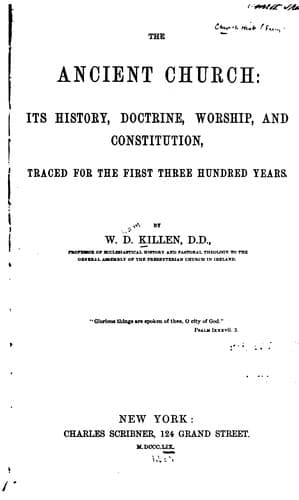
The Ancient Church: Its History, Doctrine, Worship, and ConstitutionKillen, W. D. (William Dool)
Religion
The Ancient Church: Its History, Doctrine, Worship, and Constitution
Killen, W. D. (William Dool)
Church history -- Primitive and early church, ca. 30-600
During this imprisonment at Rome, Paul dictated a number of his
epistles. Of these, the letter to Philemon, a Christian of Colosse,
seems to have been first written. The bearer of this communication was
Onesimus, who had at one time been a slave in the service of the
individual to whom it is addressed; and who, as it appears, after
robbing his master, had left the country. The thief made his way to
Rome, where he was converted under the ministry of the apostle; and
where he had since greatly recommended himself as a zealous and
trustworthy disciple. He was now sent back to Colosse with this Epistle
to Philemon, in which the writer undertakes to be accountable for the
property that had been pilfered, [150:3] and entreats his correspondent
to give a kindly reception to the penitent fugitive. Onesimus, when
conveying the letter to his old master, was accompanied by Tychicus,
whom the apostle describes as "a beloved brother and a faithful minister
and fellow-servant in the Lord" [150:4] who was entrusted with the
Epistle to the Colossians. Error, in the form of false philosophy and
Judaizing superstition, had been creeping into the Colossian Church,
[150:5] and the apostle in this letter exhorts his brethren to beware of
its encroachments. About the same time Paul wrote the Epistle to the
Ephesians; and Tychicus was also the bearer of this communication.
[150:6] Unlike most of the other epistles, it has no salutations at the
close; it is addressed, not only "to the saints which are at Ephesus" in
particular, but also "to the faithful in Christ Jesus" [151:1] in
general; and as its very superscription thus bears evidence that it was
originally intended to be a circular letter, it is probably "the epistle
from Laodicea" mentioned in the Epistle to the Colossians. [151:2] The
first division of it is eminently distinguished by the profound and
comprehensive views of the Christian system it exhibits; whilst the
latter portion is no less remarkable for the variety, pertinency, and
wisdom, of its practical admonitions. The Epistle to the Philippians was
likewise written about this period. Paul always took a deep interest in
the well-being of his earliest European converts, and here he speaks in
most hopeful terms of their spiritual condition. [151:3] They were less
disturbed by divisions and heresies than perhaps any other of the
Apostolic Churches.
CHAPTER X.
PAUL'S SECOND IMPRISONMENT, AND MARTYRDOM; PETER, HIS EPISTLES, HIS
MARTYRDOM, AND THE ROMAN CHURCH.
Public-domain text, read in full here on John Shaqi.
Reviews
Reviews
No reviews yet
Be the first to share your thoughts on this work.
Elsewhere in the archive
Join the Discussion
Join the discussion
Sign in to leave a comment or review.
Sign InorCreate an account