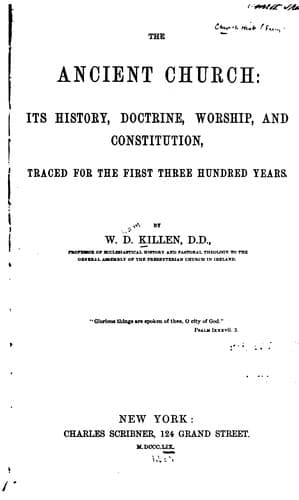
The Ancient Church: Its History, Doctrine, Worship, and ConstitutionKillen, W. D. (William Dool)
Religion
The Ancient Church: Its History, Doctrine, Worship, and Constitution
Killen, W. D. (William Dool)
Church history -- Primitive and early church, ca. 30-600
The Book of the Acts terminates abruptly; and the subsequent history of
Paul is involved in much obscurity. Some have contended that the apostle
was never released from his first imprisonment at Rome, and accordingly
consider that he was one of the earliest Christian martyrs who suffered
under the Emperor Nero. But this theory is encumbered with insuperable
difficulties. In his letters written after his first appearance in Rome,
Paul evidently anticipates his liberation; [152:1] and in some of them
he apparently speaks prophetically. Thus, he says to the Philippians--"I
am in a strait betwixt two, having a desire to depart and to be with
Christ, which is far better--nevertheless to abide in the flesh is more
needful for you--and having this confidence _I know that I shall abide
and continue_ with you all for your furtherance and joy of faith."
[152:2] The apostle had long cherished a desire to visit Spain; [152:3]
and there is evidence that he actually preached the gospel in that
country; for Clemens Romanus, who was his contemporary and
fellow-labourer, positively affirms that he travelled "to the extremity
of the west." [153:1] Clemens appears to have been himself a native of
the great metropolis; [153:2] and as he makes the statement just quoted
in a letter written from Rome, it cannot be supposed that, under such
circumstances, he would have described Italy as the boundary of the
earth. The Second Epistle to Timothy, which is generally admitted to
have been written immediately before Paul's death, contains several
passages which obviously indicate that the author had been very recently
at liberty. Thus, he says-"The cloak [153:3] (or, as some render it,
_the case_) [153:4] that I left at Troas, with Carpus, when thou comest
bring with thee, and the books, but especially the parchments." [153:5]
These words suggest that the apostle had lately visited Troas on the
coast of Asia Minor. Again, he remarks--"Erastus abode at Corinth, but
Trophimus have I left at Miletum sick." [153:6] Any ordinary reader
would at once infer from this observation that the writer had just
arrived from Miletum. [153:7] The language of the concluding verses of
the Acts warrants the impression that Paul's confinement had ended some
time before the book was completed; for had the apostle been still in
bondage, it would scarcely have been said that, when a prisoner, he
dwelt for two whole years in his own hired house--thereby implying that
the period of his residence, at least in that abode, had terminated. And
if Paul was released at the expiration of these two years, we can well
understand why the sacred historian may have deemed it inexpedient to
give an account of his liberation. The subjects of Rome at that time
were literally living under a reign of terror; and it would perhaps have
been most unwise to have proceeded farther with the narrative. Paul, as
Peter once before, [154:1] may have been miraculously delivered; and
Public-domain text, read in full here on John Shaqi.
Reviews
Reviews
No reviews yet
Be the first to share your thoughts on this work.
Elsewhere in the archive
Join the Discussion
Join the discussion
Sign in to leave a comment or review.
Sign InorCreate an account