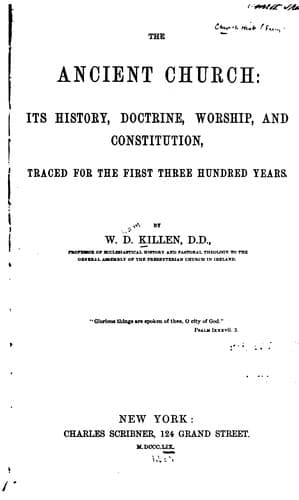
The Ancient Church: Its History, Doctrine, Worship, and ConstitutionKillen, W. D. (William Dool)
Religion
The Ancient Church: Its History, Doctrine, Worship, and Constitution
Killen, W. D. (William Dool)
Church history -- Primitive and early church, ca. 30-600
prudence may have required the concealment of his subsequent movements.
Or, the history of his release may have been so mixed up with the freaks
of the tyrant who then oppressed the Roman world, that its publication
might have brought down the imperial vengeance on the head of the
evangelist.
We have seen that Paul arrived in Rome as a prisoner in the beginning of
A.D. 61; and if at this time his confinement continued only two years,
he must have been liberated in the early part of A.D. 63. Nero had not
then commenced his memorable persecution of the Church; for the burning
of the city took place in the summer of A.D. 64; and, until that date,
the disciples do not appear to have been singled out as the special
objects of his cruelty. It is probable that Paul, after his release,
accomplished his intention of visiting the Spanish Peninsula; and, on
his return to Italy, he appears to have written the Epistle to the
Hebrews. [154:2] The destruction of Jerusalem was at this time
approaching; and, as the apostle demonstrates in this letter that the
law was fulfilled in Christ, he thus prepares the Jewish Christians for
the extinction of the Mosaic ritual. In all likelihood he now once more
visited Jerusalem, travelling by Corinth, [155:1] Philippi, [155:2] and
Troas, [155:3] where he left for the use of Carpus the case with the
books and parchments which he mentions in his Second Epistle to Timothy.
Passing on then to Colosse, [155:4] he may have visited Antioch in
Pisidia and other cities of Asia Minor, the scenes of his early
ministrations; and reached Jerusalem [155:5] by way of Antioch in Syria.
He perhaps returned from Palestine to Rome by sea, leaving Trophimus
sick [155:6] at Miletum in Crete. The journey did not probably occupy
much time; and, on his return to Italy, he seems to have been
immediately incarcerated. His condition was now very different from what
it had been during his former confinement; for he was deserted by his
friends, and treated as a malefactor. [155:7] When he wrote to Timothy
he had already been brought before the judgment-seat, and had narrowly
escaped martyrdom. "At my first answer," says he, "no man stood with me,
but all men forsook me. I pray God that it may not be laid to their
charge. Notwithstanding the Lord stood with me and strengthened me, that
by me the preaching might be fully known, and that all the Gentiles
might hear; [155:8] and I was delivered out of the mouth of the lion."
[155:9] The prospect, however, still continued gloomy; and he had no
hope of ultimate escape. In the anticipation of his condemnation, he
wrote those words so full of Christian faith and heroism, "I am now
ready to be offered, and the time of my departure is at hand. I have
fought a good fight--I have finished my course--I have kept the faith.
Henceforth there is laid up for me a crown of righteousness, which the
Lord, the righteous Judge, shall give me in that day, and not to me
Public-domain text, read in full here on John Shaqi.
Reviews
Reviews
No reviews yet
Be the first to share your thoughts on this work.
Elsewhere in the archive
Join the Discussion
Join the discussion
Sign in to leave a comment or review.
Sign InorCreate an account