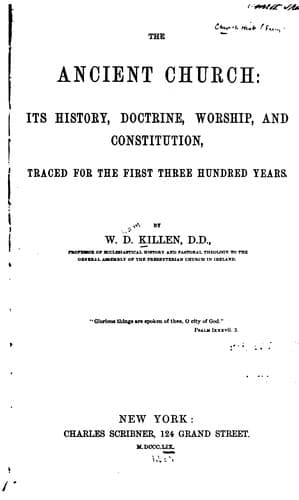
The Ancient Church: Its History, Doctrine, Worship, and ConstitutionKillen, W. D. (William Dool)
Religion
The Ancient Church: Its History, Doctrine, Worship, and Constitution
Killen, W. D. (William Dool)
Church history -- Primitive and early church, ca. 30-600
Had all the disciples been in such circumstances as the grandchildren of
Jude, the gospel might have been identified with poverty and ignorance;
and it might have been said that it was fitted to make way only among
the dregs of the population. But it was never fairly open to this
objection. From the very first it reckoned amongst its adherents at
least a sprinkling of the wealthy, the influential, and the educated.
Joseph of Arimathea, one of the primitive followers of our Lord, was "a
rich man" and an "honourable counsellor;" [170:1] Paul himself, as a
scholar, stood high among his countrymen, for he had been brought up at
the feet of Gamaliel; and Sergius Paulus, one of the first fruits of the
mission to the Gentiles, was a Roman Proconsul. [170:2] In the reign of
Nero the Church could boast of some illustrious converts; and the saints
of "Caesar's household" are found addressing their Christian salutations
to their brethren at Philippi. [170:3] In the reign of Domitian the
gospel still continued to have friends among the Roman nobility. Flavius
Clemens, a person of consular dignity, and the cousin of the Emperor,
was now put to death for his attachment to the cause of Christ; [170:4]
and his near relative Flavia Domitilla, for the same reason, was
banished with many others to Pontia, [170:5] a small island off the
coast of Italy used for the confinement of state prisoners.
Domitian governed the Empire fifteen years, but his persecution of the
Christians appears to have been limited to the latter part of his reign.
About this time the Apostle John, "for the word of God and for the
testimony of Jesus Christ," [171:1] was sent as an exile into Patmos, a
small rocky island in the Aegaean Sea not far from the coast of Asia
Minor. It is said that he had previously issued unhurt from a cauldron
of boiling oil into which he had been plunged in Rome by order of the
Emperor; but this story, for which a writer who flourished about a
century afterwards is the earliest voucher, [171:2] has been challenged
as of doubtful authority. [171:3] We have no means of ascertaining the
length of time during which he remained in banishment; [171:4] and all
we know of this portion of his life is, that he had now those sublime
and mysterious visions to be found in the Apocalypse. After the fall of
Jerusalem, as well as after he was permitted to leave Patmos, he appears
to have resided chiefly in the metropolis of the Proconsular Asia; and
hence some ancient writers, who flourished after the establishment of
the episcopal system, have designated him the "Bishop of Ephesus."
[172:1] But the apostle, when advanced in life, chose to be known simply
by the title of "the elder;" [172:2] and though he was certainly by far
the most influential minister of the district where he sojourned, there
is every reason to believe that he admitted his brethren to a share in
the government of the Christian community. Like Peter and Paul before
Public-domain text, read in full here on John Shaqi.
Reviews
Reviews
No reviews yet
Be the first to share your thoughts on this work.
Elsewhere in the archive
Join the Discussion
Join the discussion
Sign in to leave a comment or review.
Sign InorCreate an account