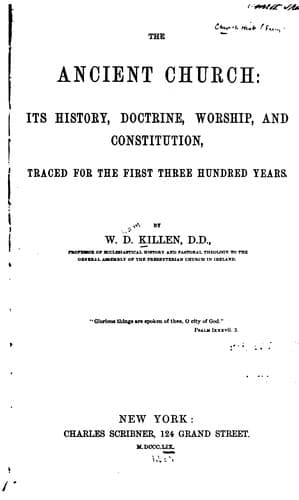
The Ancient Church: Its History, Doctrine, Worship, and ConstitutionKillen, W. D. (William Dool)
Religion
The Ancient Church: Its History, Doctrine, Worship, and Constitution
Killen, W. D. (William Dool)
Church history -- Primitive and early church, ca. 30-600
him, he acknowledged the other elders as his "fellow-presbyters,"
[172:3] and, as became his age and apostolic character, he doubtless
exhorted them to take heed unto themselves and to all the flock over the
which the Holy Ghost had made them overseers. [172:4]
John seems to have been the last survivor of the apostles. He is said to
have reached the advanced age of one hundred years, and to have died
about the close of the first century. He was a "Son of Thunder," [172:5]
and he appears to have long maintained the reputation of a powerful and
impressive preacher; but when his strength began to give way beneath the
pressure of increasing infirmities, he ceased to deliver lengthened
addresses. When he appeared before the congregation in extreme old age,
he is reported to have simply repeated the exhortation "Children, love
one another;" and when asked, why he always confined himself to the same
brief admonition, he replied that "no more was necessary." [172:6] Such
a narrative is certainly quite in harmony with the character of the
beloved disciple, for he knew that love is the "bond of perfectness" and
"the fulfilling of the law."
It has been thought that, towards the close of the first century, the
Christian interest was in a somewhat languishing condition; [172:7] and
the tone of the letters addressed to the Seven Churches in Asia is
calculated to confirm this impression. The Church of Laodicea is said to
be "neither cold nor hot;" [173:1] the Church of Sardis is admonished to
"strengthen the things which remain that are ready to die;" [173:2] and
the Church of Ephesus is exhorted to "remember from whence she has
fallen, and repent, and do the first works." [173:3] When it was known
that Christianity was under the ban of a legal proscription, it was not
strange that "the love of many" waxed cold; and the persecutions of Nero
and Domitian must have had a most discouraging influence. But though the
Church had to encounter the withering blasts of popular odium and
imperial intolerance, it struggled through an ungenial spring; and, in
almost every part of the Roman Empire, it had taken root and was
beginning to exhibit tokens of a steady and vigorous growth as early as
the close of the first century. The Acts and the apostolical epistles
speak of the preaching of the gospel in Palestine, Syria, Cyprus, Asia
Minor, Greece, Illyricum, and Italy; and, according to traditions which
we have no reason to discredit, the way of salvation was proclaimed,
before the death of John, in various other countries. It is highly
probable that Paul himself assisted in laying the foundations of the
Church in Spain; at an early date there were disciples in Gaul; and
there is good evidence that, before the close of the first century, the
new faith had been planted even on the distant shores of Britain.
[173:4] It is generally admitted that Mark laboured successfully as an
evangelist in Alexandria, the metropolis of Egypt; [173:5] and it has
Public-domain text, read in full here on John Shaqi.
Reviews
Reviews
No reviews yet
Be the first to share your thoughts on this work.
Elsewhere in the archive
Join the Discussion
Join the discussion
Sign in to leave a comment or review.
Sign InorCreate an account