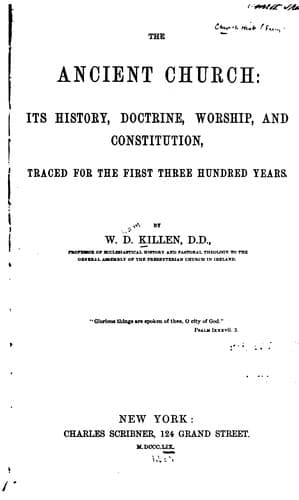
The Ancient Church: Its History, Doctrine, Worship, and ConstitutionKillen, W. D. (William Dool)
Religion
The Ancient Church: Its History, Doctrine, Worship, and Constitution
Killen, W. D. (William Dool)
Church history -- Primitive and early church, ca. 30-600
been conjectured that Christians were soon to be found in "the parts of
Libya about Cyrene," [173:6] for if Jews from that district were
converted at Jerusalem by Peter's famous sermon on the day of Pentecost,
they would not fail, on their return home, to disseminate the precious
truths by which they had been quickened and comforted. On the same
grounds it may be inferred that the gospel soon found its way into
Parthia, Media, Persia, Arabia, and Mesopotamia. [174:1] Various
traditions [174:2] attest that several of the apostles travelled
eastwards, after their departure from the capital of Palestine.
Whilst Christianity, in the face of much obloquy, was gradually
attracting more and more attention, it was at the same time nobly
demonstrating its power as the great regenerator of society. The
religion of pagan Rome could not satisfy the wants of the soul; it could
neither improve the heart nor invigorate the intellect; and it was now
rapidly losing its hold on the consciences of the multitude. The high
places of idolatrous worship often exercised a most demoralising
influence, as their rites were not unfrequently a wretched mixture of
brutality, levity, imposture, and prostitution. Philosophy had
completely failed to ameliorate the condition of man. The vices of some
of its most distinguished professors were notorious; its votaries were
pretty generally regarded as a class of scheming speculators; and they
enjoyed neither the confidence nor the respect of the mass of the
people. But, even under the most unpromising circumstances, it soon
appeared that Christianity could accomplish social and spiritual changes
of a very extraordinary character. The Church of Corinth was perhaps one
of the least exemplary of the early Christian communities, and yet it
stood upon a moral eminence far above the surrounding population; and,
from the roll of its own membership, it could produce cases of
conversion to which nothing parallel could, be found in the whole
history of heathendom. Paul could say to it--"Neither fornicators, nor
idolaters, nor adulterers, nor effeminate, nor abusers of themselves
with mankind, nor thieves, nor covetous, nor drunkards, nor revilers,
nor extortioners, shall inherit the kingdom of God, _and such were some
of you_ but ye are washed, but ye _are sanctified_, but ye are justified
in the name of the Lord Jesus, and by the Spirit of our God." [175:1]
Nor was this all. The gospel proved itself sufficient to meet the
highest aspirations of man. It revealed to him a Friend in heaven who
"sticketh closer than a brother;" [175:2] and, as it assured him of
eternal happiness in the enjoyment of fellowship with God, it imparted
to him a "peace that passeth all understanding." The Roman people
witnessed a new spectacle when they saw the primitive followers of
Christ expiring in the fires of martyrdom. The pagans did not so value
their superstitions; but here was a religion which was accounted "better
Public-domain text, read in full here on John Shaqi.
Reviews
Reviews
No reviews yet
Be the first to share your thoughts on this work.
Elsewhere in the archive
Join the Discussion
Join the discussion
Sign in to leave a comment or review.
Sign InorCreate an account