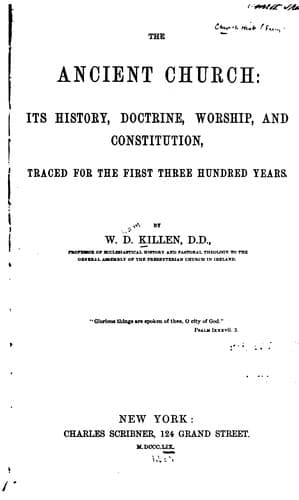
The Ancient Church: Its History, Doctrine, Worship, and ConstitutionKillen, W. D. (William Dool)
Religion
The Ancient Church: Its History, Doctrine, Worship, and Constitution
Killen, W. D. (William Dool)
Church history -- Primitive and early church, ca. 30-600
It is highly probable that some of the fourteen epistles of Paul were
written before any other portion of the New Testament, for we have
already seen [180:2] that the greater number of them were transmitted to
the parties to whom they are addressed during the time over which the
Acts of the Apostles extend; but though Luke makes no mention of these
letters, his account of the travels of their author throws considerable
light on the question of their chronology. Guided by statements which he
supplies, and by evidence contained in the documents themselves, we have
endeavoured to point out the order of their composition. It thus appears
that they are not placed chronologically in the New Testament. The
present arrangement is, however, of great antiquity, as it can be traced
up to the beginning of the fourth century; [180:3] and it is made upon
the principle that the Churches addressed should be classed according to
their relative importance. The Church of Rome at an early period was
recognised as the most influential in existence, and hence the Epistle
to the Romans stands at the head of the collection. The Church of
Corinth seems to have ranked next, and accordingly the Epistles to the
Corinthians occupy the second place. The letters to the Churches are
followed by those to individuals, that is, to Timothy, Titus, and
Philemon; and it has been conjectured that the Epistle to the Hebrews is
put last, because it is anonymous. Some have contended that this letter
was composed by Barnabas; others have ascribed it to Clement, or Luke,
or Silas, or Apollos; but, though Paul has not announced his name, the
external and internal evidences concur to prove that he was its author.
[181:1]
Public-domain text, read in full here on John Shaqi.
Reviews
Reviews
No reviews yet
Be the first to share your thoughts on this work.
Elsewhere in the archive
Join the Discussion
Join the discussion
Sign in to leave a comment or review.
Sign InorCreate an account