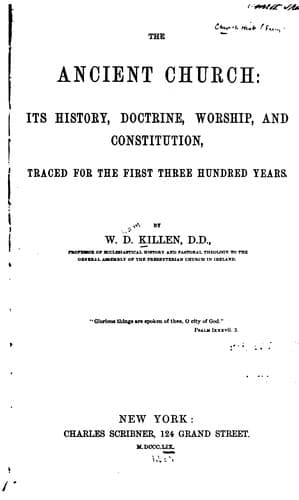
The Ancient Church: Its History, Doctrine, Worship, and ConstitutionKillen, W. D. (William Dool)
Religion
The Ancient Church: Its History, Doctrine, Worship, and Constitution
Killen, W. D. (William Dool)
Church history -- Primitive and early church, ca. 30-600
"Every word of God is pure," [181:2] but the word of man is often
deceitful; and nowhere do his fallibility and ignorance appear more
conspicuously than in his appendages to Scripture. Even the titles
prefixed to the writings of the apostles and evangelists are redolent of
superstition, for no satisfactory reason can be given why the
designation of _saint_, [181:3] has been bestowed on Matthew, Mark,
Luke, and John, whilst it is withheld, not only from Moses and Isaiah,
but also from such eminently holy ministers as Timothy and Titus. The
postscripts to the epistles of Paul have been added by transcribers, and
are also calculated to mislead. Thus, the Epistle to the Galatians is
said to have been "written from Rome," though it is now generally
acknowledged that Paul was not in the capital of the Empire until long
after that letter was dictated. The first Epistle to Timothy is dated
"from Laodicea, which is the chiefest city of Phrygia Pacatiana;" but it
is well known that Phrygia was not divided into Phrygia Prima, or
Pacatiana, and Phrygia Secunda until the fourth century. [181:4] It is
stated at the end of another epistle that it was "written to Titus
ordained the first Bishop of the Church of the Cretians;" but, as the
letter itself demonstrates, Paul did not intend that Titus should remain
permanently in Crete, [182:1] and it can be shewn that, for centuries
afterwards, such a dignitary as "the Bishop of the Church of the
Cretians" was utterly unknown.
The seven letters written by James, Peter, Jude, and John, are called
General or Catholic epistles. The Epistle of James was addressed "to the
twelve tribes scattered abroad" probably in A.D. 61, and its author
survived its publication perhaps little more than twelve months. [182:2]
Peter, as we have seen, appears to have written his two epistles only a
short time before his martyrdom. [182:3] The Epistle of Jude is the
production of a later period, as it contains quotations from the Second
Epistle of Peter. [182:4] The exact dates of the Epistles of John cannot
now be discovered, but they supply internal proof that they must have
been written towards the close of the first century. [182:5]
According to some, the Apocalypse, or Revelation of John, was drawn up
before the destruction of Jerusalem, and in the time of the Emperor
Nero; but the arguments in support of so early an origin are very
unsatisfactory. Ancient writers [182:6] attest that it was written in
the reign of Domitian towards the close of the first century, and the
truth of this statement is established by various collateral evidences.
Public-domain text, read in full here on John Shaqi.
Reviews
Reviews
No reviews yet
Be the first to share your thoughts on this work.
Elsewhere in the archive
Join the Discussion
Join the discussion
Sign in to leave a comment or review.
Sign InorCreate an account