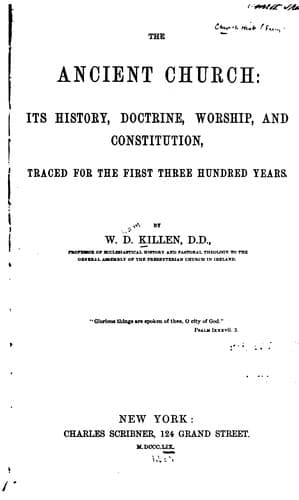
The Ancient Church: Its History, Doctrine, Worship, and ConstitutionKillen, W. D. (William Dool)
Religion
The Ancient Church: Its History, Doctrine, Worship, and Constitution
Killen, W. D. (William Dool)
Church history -- Primitive and early church, ca. 30-600
The Greek word translated _heresy_ [200:1] in our authorised version of
the New Testament, did not primarily convey an unfavourable idea. It
simply denoted a _choice_ or _preference_. It was often employed to
indicate the adoption of a particular class of philosophical sentiments;
and thus it came to signify a _sect_ or _denomination_. Hence we find
ancient writers speaking of the _heresy_ of the Stoics, the _heresy_
of
the Epicureans, and the _heresy_ of the Academics. The Jews who used the
Greek language did not consider that the word necessarily reflected on
the party it was intended to describe; and Josephus, who was himself a
Pharisee, accordingly discourses of the three heresies of the Pharisees,
the Sadducees, and the Essenes. [200:2] The Apostle Paul, when speaking
of his own history prior to his conversion, says, that "after the
strictest heresy" of his religion he lived a Pharisee. [200:3] We learn,
too, from the book of the Acts, that the early Christians were known as
"the heresy of the Nazarenes." [200:4] But very soon the word began to
be employed to denote something which the gospel could not sanction; and
accordingly, in the Epistle to the Galatians, heresies are enumerated
among the works of the flesh. [200:5] It is not difficult to explain why
Christian writers at an early date were led to attach such a meaning to
a term which had hitherto been understood to imply nothing
reprehensible. The New Testament teaches us to regard an erroneous
theology as sinful, and traces every deviation from "the one faith" of
the gospel to the corruption of a darkened intellect. [201:1] It
declares--"He that believeth not is _condemned already_, because he hath
not believed in the name of the only-begotten Son of God; and this is
the condemnation, that light is come into the world, and men loved
darkness rather than light, _because their deeds were evil_." [201:2]
Thus it was that the most ancient ecclesiastical authors described all
classes of unbelievers, sceptics, and innovators, under the general name
of heretics. Persons who in matters of religion made a _false choice_,
of whatever kind, were viewed as "vainly puffed up by a fleshly mind,"
or as under the influence of some species of mental depravity.
It thus appears that heresy, in the first century, denoted every
deviation from the Christian faith. Pagans and Jews, as well as
professors of apocryphal forms of the gospel, were called heretics.
[201:3] But in the New Testament our attention is directed chiefly to
errorists who in some way disturbed the Church, and adulterated the
doctrine taught by our Lord and His apostles. Paul refers to such
characters when he says--"A man that is an heretic, after the first and
second admonition, reject;" [201:4] and Peter also alludes to them when
he speaks of false teachers who were to appear and "privily bring in
damnable heresies." [201:5]
Public-domain text, read in full here on John Shaqi.
Reviews
Reviews
No reviews yet
Be the first to share your thoughts on this work.
Elsewhere in the archive
Join the Discussion
Join the discussion
Sign in to leave a comment or review.
Sign InorCreate an account