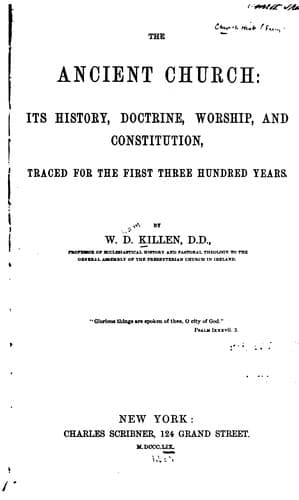
The Ancient Church: Its History, Doctrine, Worship, and ConstitutionKillen, W. D. (William Dool)
Religion
The Ancient Church: Its History, Doctrine, Worship, and Constitution
Killen, W. D. (William Dool)
Church history -- Primitive and early church, ca. 30-600
The earliest corrupters of the gospel were unquestionably those who
endeavoured to impose the observance of the Mosaic law on the converted
Gentiles. Their proceedings were condemned in the Council of Jerusalem,
mentioned in the fifteenth chapter of the Acts of the Apostles; and
Paul, in his letter to the Galatians, subsequently exposed their
infatuation. But evangelical truth had, perhaps, more to fear from
dilution with the speculations of the Jewish and pagan literati. [202:1]
The apostle had this evil in view when he said to the Colossians--
"Beware lest any man spoil you through _philosophy_ and vain
deceit, after the tradition of men, after the _rudiments of the world_,
and not after Christ." [202:2] He likewise emphatically attested the
danger to be apprehended from it when he addressed to his own son in the
faith the impassioned admonition--"O Timothy, keep that which is
committed to thy trust, avoiding profane and vain babblings, and
_oppositions of science_ falsely so called." [202:3]
There is no reason to doubt that the "science" or "philosophy" of which
Paul was so anxious that the disciples should beware, was the same which
was afterwards so well known by the designation of _Gnosticism_. The
second century was the period of its most vigorous development, and it
then, for a time, almost engrossed the attention of the Church; but it
was already beginning to exert a pernicious influence, and it is
therefore noticed by the vigilant apostle. Whilst it acknowledged, to a
certain extent, the authority of the Christian revelation, it also
borrowed largely from Platonism; and, in a spirit of accommodation to
the system of the Athenian sage, it rejected some of the leading
doctrines of the gospel. Plato never seems to have entertained the
sublime conception of the creation of all things out of nothing by the
word of the Most High. He held that matter is essentially evil, and that
it existed from eternity. [202:4] The false teachers who disturbed the
Church in the apostolic age adopted both these views; and the errors
which they propagated and of which the New Testament takes notice,
flowed from their unsound philosophy by direct and necessary
consequence. As a right understanding of certain passages of Scripture
depends on an acquaintance with their system, it may here be expedient
to advert somewhat more particularly to a few of its peculiar features.
Public-domain text, read in full here on John Shaqi.
Reviews
Reviews
No reviews yet
Be the first to share your thoughts on this work.
Elsewhere in the archive
Join the Discussion
Join the discussion
Sign in to leave a comment or review.
Sign InorCreate an account