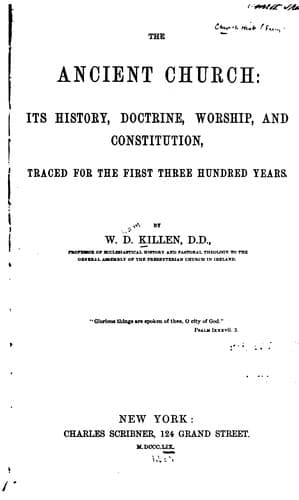
The Ancient Church: Its History, Doctrine, Worship, and ConstitutionKillen, W. D. (William Dool)
Religion
The Ancient Church: Its History, Doctrine, Worship, and Constitution
Killen, W. D. (William Dool)
Church history -- Primitive and early church, ca. 30-600
Though the Jews, at the time of the appearance of our Lord, were so much
divided in sentiment, and though the Pharisees, the Sadducees, and the
Essenes, had each their theological peculiarities, their sectarianism
did not involve any complete severance or separation. Notwithstanding
their differences of creed, the Pharisees and Sadducees sat together in
the Sanhedrim, [207:2] and worshipped together in the temple. All the
seed of Abraham constituted one Church, and congregated in the same
sacred courts to celebrate the great festivals. In the Christian Church,
in the days of the apostles, there was something approaching to the same
outward unity. Though, for instance, there were so many parties among
the Corinthians--though one said, I am of Paul, and another I am of
Apollos, and another I am of Cephas, and another I am of Christ--all
assembled in the same place to join in the same worship, and to partake
of the same Eucharist. Those who withdrew from the disciples with whom
they had been previously associated, appear generally to have
relinquished altogether the profession of Christianity. [207:3] Some, at
least, of the Gnostics acted very differently. When danger appeared they
were inclined to temporize, and to discontinue their attendance on the
worship of the Church; but they were desirous to remain still nominally
connected with the great body of believers. [207:4] Any form of alliance
with such dangerous errorists was, however, considered a cause of
scandal; and the inspired teachers of the gospel insisted on their
exclusion from ecclesiastical fellowship. Hence Paul declares that he
had delivered Hymenaeus and Alexander "unto Satan" that they might learn
"not to blaspheme;" [208:1] and John upbraids the Church in Pergamos
because it retained in its communion "them that held the doctrine of the
Nicolaitanes." [208:2] During the first century the Gnostics seem to
have been unable to create anything like a schism among those who had
embraced Christianity. Whilst the apostles lived the "science falsely so
called" could not pretend to a divine sanction; and though here and
there they displayed considerable activity in the dissemination of their
principles, they were sternly and effectually discountenanced. It is
accordingly stated by one of the earliest ecclesiastical writers that,
in the time of Simeon of Jerusalem, who finished his career in the
beginning of the second century, "they called the Church as yet a
virgin, inasmuch as it was not yet corrupted by vain discourses."
[208:3] Other writers concur in bearing testimony to the fact that,
whilst the apostles were on earth, false teachers failed "to divide the
unity" of the Christian commonwealth, "by the introduction of corrupt
doctrines." [208:4]
Public-domain text, read in full here on John Shaqi.
Reviews
Reviews
No reviews yet
Be the first to share your thoughts on this work.
Elsewhere in the archive
Join the Discussion
Join the discussion
Sign in to leave a comment or review.
Sign InorCreate an account