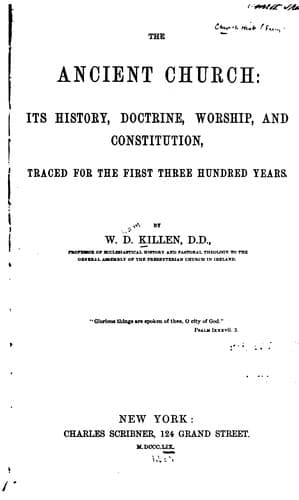
The Ancient Church: Its History, Doctrine, Worship, and ConstitutionKillen, W. D. (William Dool)
Religion
The Ancient Church: Its History, Doctrine, Worship, and Constitution
Killen, W. D. (William Dool)
Church history -- Primitive and early church, ca. 30-600
The gospel affords scope for the healthful and vigorous exercise of the
human understanding, and it is itself the highest and the purest wisdom.
It likewise supplies a test for ascertaining the state of the heart.
Those who receive it with faith unfeigned will delight to meditate on
its wonderful discoveries; but those who are unrenewed in the spirit of
their minds will render to it only a doubtful submission, and will
pervert its plainest announcements. The apostle therefore says--"There
must be also heresies among you, that they which are approved may be
made manifest among you." [208:5] The heretic is made manifest alike by
his deviations from the doctrines and the precepts of revelation. His
creed does not exhibit the consistency of truth, and his life fails to
display the beauty of holiness. Bible Christianity is neither
superstitious nor sceptical, neither austere nor sensual. "The wisdom
that is from above is _first pure,_ then peaceable, gentle, and easy to
be intreated, _full of mercy and good fruits_, without partiality and
without hypocrisy." [209:1]
SECTION III.
THE WORSHIP AND CONSTITUTION OF THE APOSTOLIC CHURCH.
CHAPTER I.
THE LORD'S DAY--THE WORSHIP OF THE APOSTOLIC CHURCH--ITS SYMBOLIC
ORDINANCES AND ITS DISCIPLINE.
To the primitive disciples the day on which our Lord rose from the grave
was a crisis of intense excitement. The crucifixion had cast a dismal
cloud over their prospects; for, immediately before, when He entered
Jerusalem amidst the hosannahs of the multitude, they had probably
anticipated that He was about to assert His sovereignty as the Messiah:
yet, when His body was committed to the tomb, they did not at once sink
into despair; and, though filled with anxiety, they ventured to indulge
a hope that the third day after His demise would be signalised by some
new revelation. [210:1] The report of those who were early at the
sepulchre at first inspired the residue of the disciples with wonder and
perplexity; [210:2] but, as the proofs of His resurrection multiplied,
they became confident and joyful. Ever afterwards the first day of the
week was observed by them as the season of holy convocation. [211:1]
Those members of the Apostolic Church who had been originally Jews,
continued for some time to meet together also on the Saturday; but, what
was called "The Lord's Day," [211:2] was regarded by all as sacred to
Christ.
Public-domain text, read in full here on John Shaqi.
Reviews
Reviews
No reviews yet
Be the first to share your thoughts on this work.
Elsewhere in the archive
Join the Discussion
Join the discussion
Sign in to leave a comment or review.
Sign InorCreate an account