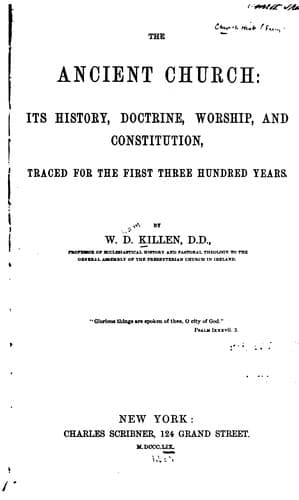
The Ancient Church: Its History, Doctrine, Worship, and ConstitutionKillen, W. D. (William Dool)
Religion
The Ancient Church: Its History, Doctrine, Worship, and Constitution
Killen, W. D. (William Dool)
Church history -- Primitive and early church, ca. 30-600
to freeze the genial current of devotion.
Singing, in which none but Levites were permitted to unite, [216:1] and
which was accompanied by instrumental music, constituted a prominent
part of the temple service. The singers occupied an elevated platform
adjoining the court of the priests; [216:2] and it is somewhat doubtful
whether, in that position, they were distinctly heard by the majority of
the worshippers within the sacred precincts. [216:3] As the sacrifices,
offerings, and other observances of the temple, as well as the priests,
the vestments, and even the building itself, had an emblematic meaning,
[216:4] it would appear that the singing, intermingled with the music of
various instruments of sound, was also typical and ceremonial. It seems
to have indicated that the tongue of man cannot sufficiently express the
praise of the King Eternal, and that all things, animate and inanimate,
owe Him a revenue of glory. The worship of the synagogue was more
simple. Its officers had, indeed, trumpets and cornets, with which they
published their sentences of excommunication, and announced the new
year, the fasts, and the Sabbath; [216:5] but they did not introduce
instrumental music into their congregational services. The early
Christians followed the example of the synagogue; and when they
celebrated the praises of God "in psalms, and hymns, and spiritual
songs," [216:6] their melody was "the fruit of the lips." [216:7] For
many centuries after this period, the use of instrumental music was
unknown in the Church. [217:1]
The Jews divided the Pentateuch and the writings of the Prophets into
sections, one of which was read every Sabbath in the synagogue; [217:2]
and thus, in the place set apart to the service of the God of Israel,
His own will was constantly proclaimed. The Christians bestowed equal
honour on the holy oracles; for in their solemn assemblies, the reading
of the Scriptures of the Old and New Testament formed a part of their
stated worship. [217:3] At the close of this exercise, one or more of
the elders edified the congregation, either by giving a general
exposition of the passage read, or by insisting particularly on some
point of doctrine or duty which it obviously inculcated. If a prophet
was present, he, too, had now an opportunity of addressing the auditory.
[217:4]
Public-domain text, read in full here on John Shaqi.
Reviews
Reviews
No reviews yet
Be the first to share your thoughts on this work.
Elsewhere in the archive
Join the Discussion
Join the discussion
Sign in to leave a comment or review.
Sign InorCreate an account