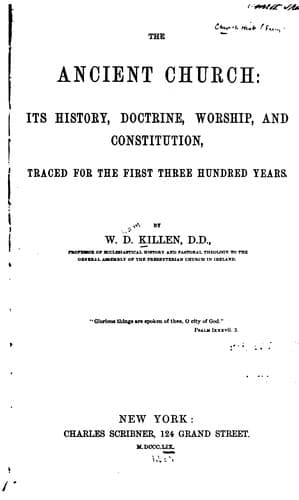
The Ancient Church: Its History, Doctrine, Worship, and ConstitutionKillen, W. D. (William Dool)
Religion
The Ancient Church: Its History, Doctrine, Worship, and Constitution
Killen, W. D. (William Dool)
Church history -- Primitive and early church, ca. 30-600
Though the New Testament furnishes no full and circumstantial
description of the worship of the Christian Church, it makes such
incidental allusions to its various parts, as enable us to form a pretty
accurate idea of its general character. Like the worship of the
synagogue [214:2] it consisted of prayer, singing, reading the
Scriptures, and expounding or preaching. Those who joined the Church,
for several years after it was first organized, were almost exclusively
converts from Judaism, and when they embraced the Christian faith, they
retained the order of religious service to which they had been hitherto
accustomed; but by the recognition of Jesus Christ as the Messiah of
whom the law and the prophets testified, their old forms were inspired
with new life and significance. At first the heathen did not challenge
the distinction between the worship of the synagogue and the Church; and
thus it was, as has already been intimated, that for a considerable
portion of the first century, the Christians and the Jews were
frequently confounded.
It has often been asserted, that the Jews had a liturgy when our Lord
ministered in their synagogues; but the proof adduced in support of this
statement is far from satisfactory; and their prayers which are still
extant, and which are said to have been then in use, must obviously have
been written after the destruction of Jerusalem. [215:1] It is, however,
certain that the Christians in the apostolic age were not restricted to
any particular forms of devotion. The liturgies ascribed to Mark, James,
and others, are unquestionably the fabrications of later times; [215:2]
and had any of the inspired teachers of the gospel composed a book of
common prayer, it would, of course, have been received into the canon of
the New Testament. Our Lord taught His disciples to pray, and supplied
them with a model to guide them in their devotional exercises; [215:3]
but there is no evidence whatever that, in their stated services, they
constantly employed the language of that beautiful and comprehensive
formulary. The very idea of a liturgy was altogether alien to the spirit
of the primitive believers. They were commanded to give thanks "in
everything," [215:4] to pray "always _with all prayer and supplication_
in the spirit," [215:5] and to watch thereunto "with all perseverance
and supplication _for all saints_;" [215:6] and had they been limited to
a form, they would have found it impossible to comply with these
admonitions. Their prayers were dictated by the occasion, and varied
according to passing circumstances. Some of them which have been
recorded, [215:7] had a special reference to the occurrences of the day,
and could not have well admitted of repetition. In the apostolic age,
when the Spirit was poured out in such rich effusion on the Church, the
gift, as well as the grace, of prayer was imparted abundantly, so that a
liturgy would have been deemed superfluous, if not directly calculated
Public-domain text, read in full here on John Shaqi.
Reviews
Reviews
No reviews yet
Be the first to share your thoughts on this work.
Elsewhere in the archive
Join the Discussion
Join the discussion
Sign in to leave a comment or review.
Sign InorCreate an account