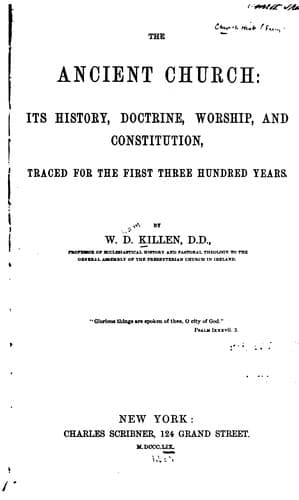
The Ancient Church: Its History, Doctrine, Worship, and ConstitutionKillen, W. D. (William Dool)
Religion
The Ancient Church: Its History, Doctrine, Worship, and Constitution
Killen, W. D. (William Dool)
Church history -- Primitive and early church, ca. 30-600
As baptism was designed to supersede the Jewish circumcision, the Lord's
Supper was intended to occupy the place of the Jewish Passover. [221:5]
The Paschal lamb could be sacrificed nowhere except in the temple of
Jerusalem, and the Passover was kept only once a year; but the Eucharist
could be dispensed wherever a Christian congregation was collected; and
at this period it seems to have been observed every first day of the
week, at least by the more zealous and devout worshippers. [221:6] The
wine, as well as the other element, was given to all who joined in its
celebration; and the title of the "Breaking of _Bread_," [221:7] one of
the names by which the ordinance was originally distinguished, supplies
evidence that the doctrine of transubstantiation was then utterly
unknown. The word _Sacrament_, as applied to Baptism and the Holy
Supper, was not in use in the days of the apostles, and the subsequent
introduction of this nomenclature, [222:1] probably contributed to throw
an air of mystery around these institutions. The primitive disciples
considered the elements employed in them simply as signs and seals of
spiritual blessings; and they had no more idea of regarding the bread in
the Eucharist as the real body of our Saviour, than they had of
believing that the water of baptism is the very blood in which He washed
His people from their sins. They knew that they enjoyed the light of His
countenance in prayer, in meditation, and in the hearing of His Word;
and that He was not otherwise present in these symbolic ordinances.
Whilst, in the Lord's Supper, believers hold fellowship with Christ,
they also maintain and exhibit their communion with each other. "We,
being many," says Paul, "are one bread and one body, for we are all
partakers of that one bread." [222:2] Those who joined together in the
observance of this holy institution were thereby pledged to mutual love;
but every one who acted in such a way as to bring reproach upon the
Christian name, was no longer admitted to the sacred table. Paul,
doubtless, refers to exclusion from this ordinance, as well as from
intimate civil intercourse, when he says to the Corinthians--"I have
written unto you not to keep company, if any man that is called a
brother be a fornicator, or covetous, or an idolater, or a railer, or a
drunkard, or an extortioner; with such an one no not to eat." [222:3]
Public-domain text, read in full here on John Shaqi.
Reviews
Reviews
No reviews yet
Be the first to share your thoughts on this work.
Elsewhere in the archive
Join the Discussion
Join the discussion
Sign in to leave a comment or review.
Sign InorCreate an account