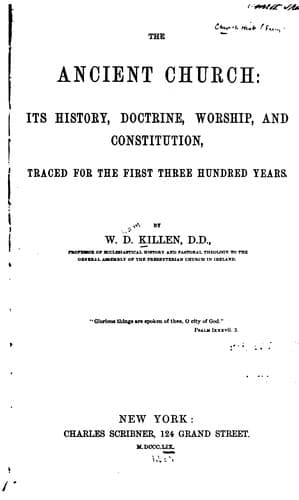
The Ancient Church: Its History, Doctrine, Worship, and ConstitutionKillen, W. D. (William Dool)
Religion
The Ancient Church: Its History, Doctrine, Worship, and Constitution
Killen, W. D. (William Dool)
Church history -- Primitive and early church, ca. 30-600
In the New Testament faith is represented as the grand qualification for
baptism; [219:3] but this principle obviously applies only to all who
are capable of believing; for in the Word of God faith is also
represented as necessary to salvation, [219:4] and yet it is generally
conceded that little children may be saved. Under the Jewish
dispensation infants were circumcised, and were thus recognised as
interested in the divine favour, so that, if they be excluded from the
rite of baptism, it follows that they occupy a worse position under a
milder and more glorious economy. But the New Testament forbids us to
adopt such an inference. It declares that infants should be "suffered to
come" to the Saviour; [219:5] it indicates that baptism supplies the
place of circumcision, for it connects the gospel institution with "the
circumcision of Christ;" [220:1] it speaks of children as "saints" and
as "in the Lord," [220:2] and, of course, as having received some
visible token of Church membership; and it assures them that their sins
are forgiven them "for His name's sake." [220:3] The New Testament does
not record a single case in which the offspring of Christian parents
were admitted to baptism on arriving at years of intelligence; but it
tells of the apostles exhorting the men of Judea to repent and to submit
to the ordinance, inasmuch as it was a privilege proffered to them and
_to their children_. [220:4] Nay more, Paul plainly teaches that the
seed of the righteous are entitled to the recognition of saintship; and
that, even when only one of the parents is a Christian, the offspring do
not on that account forfeit their ecclesiastical inheritance. "The
unbelieving husband," says he, "is sanctified by the wife, and the
unbelieving wife is sanctified by the husband, else were your _children_
unclean, but _now are they holy_." [220:5] This passage demonstrates
that the Apostolic Church recognised the holiness of infants, or in
other words, that it admitted them to baptism.
The Scriptures furnish no very specific instructions as to the mode of
baptism; and it is probable that, in its administration, the primitive
heralds of the gospel did not adhere to a system of rigid uniformity.
[220:6] Some have asserted that the Greek word translated _baptize_,
[220:7] in our authorised version, always signifies _immerse_, but it
has been clearly shewn [221:1] that this statement is inaccurate, and
that baptism does not necessarily imply _dipping_. In ancient times, and
in the lands where the apostles laboured, bathing was perhaps as
frequently performed by _affusion_ as immersion; [221:2] and it may be
that the apostles varied their method of baptizing according to
circumstances. [221:3] The ordinance was intended to convey the idea of
_washing_ or purifying; and it is obvious that water may be applied, in
many ways, as the means of ablution. In the sacred volume _sprinkling_
is often spoken of as equivalent to washing. [221:4]
Public-domain text, read in full here on John Shaqi.
Reviews
Reviews
No reviews yet
Be the first to share your thoughts on this work.
Elsewhere in the archive
Join the Discussion
Join the discussion
Sign in to leave a comment or review.
Sign InorCreate an account