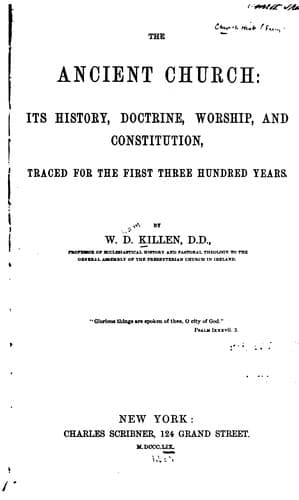
The Ancient Church: Its History, Doctrine, Worship, and ConstitutionKillen, W. D. (William Dool)
Religion
The Ancient Church: Its History, Doctrine, Worship, and Constitution
Killen, W. D. (William Dool)
Church history -- Primitive and early church, ca. 30-600
How different was this discipline from that which was established,
several centuries afterwards, in the Latin Church! The spirit and usages
of paganism then supplanted the regulations of the New Testament, and
the excommunication of Christianity was converted into the
excommunication of Druidism. [229:2] Our Lord taught that "whoever would
not hear the church" should be treated as a heathen man and a publican;
but the time came when he who forfeited his status as a member of the
Christian commonwealth was denounced as a monster or a fiend. Paul
declared that the person excommunicated, instead of being counted as an
enemy, should be admonished as a brother; but the Latin Church, in a
long list of horrid imprecations, [229:3] invoked a curse upon every
member of the body of the offender, and commanded every one to refuse to
him the civility of the coldest salutation! The early Church acted as a
faithful monitor, anxious to reclaim the sinner from the error of his
ways: the Latin Church, like a tyrant, refuses to the transgressor even
that which is his due, and seeks either to reduce him to slavery, or to
drive him to despair.
CHAPTER II.
THE EXTRAORDINARY TEACHERS OF THE APOSTOLIC CHURCH; AND ITS ORDINARY
OFFICE-BEARERS, THEIR APPOINTMENT, AND ORDINATION.
Paul declares that Christ "gave some, apostles; and some, prophets; and
some, evangelists; and some, pastors and teachers; for the perfecting of
the saints, for the work of the ministry, for the edifying of the body
of Christ." [230:1] In another place the same writer, when speaking of
those occupying positions of prominence in the ecclesiastical community,
makes a somewhat similar enumeration. "God," says he, "hath set some in
the church, first, apostles; secondarily, prophets; thirdly, teachers;
after that, miracles; then, gifts of healings, helps, governments,
diversities of tongues." [230:2]
Public-domain text, read in full here on John Shaqi.
Reviews
Reviews
No reviews yet
Be the first to share your thoughts on this work.
Elsewhere in the archive
Join the Discussion
Join the discussion
Sign in to leave a comment or review.
Sign InorCreate an account