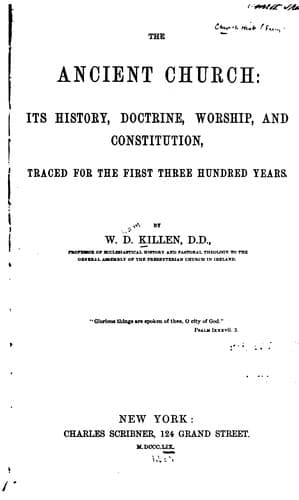
The Ancient Church: Its History, Doctrine, Worship, and ConstitutionKillen, W. D. (William Dool)
Religion
The Ancient Church: Its History, Doctrine, Worship, and Constitution
Killen, W. D. (William Dool)
Church history -- Primitive and early church, ca. 30-600
These two passages, presenting something like catalogues of the most
prominent characters connected with the Apostolic Church, throw light
upon each other. They mention the ordinary, as well as the
extraordinary, ecclesiastical functionaries. Under the class of ordinary
office-bearers must be placed those described as "pastors and teachers,"
"helps," and "governments." The evangelists, such as Timothy, [230:3]
Titus, and Philip, [230:4] seem to have had a special commission to
assist in organizing the infant Church; [230:5] and, as they were
furnished with supernatural endowments, [231:1] they may be considered
extraordinary functionaries. The apostles themselves clearly belong to
the same denomination. They all possessed the gift of inspiration
[231:2] they all received their authority immediately from Christ;
[231:3] they all "went in and out with Him" during His personal
ministry; and, as they all saw Him after He rose from the dead, they
could all attest His resurrection. [231:4] It is plain, too, that the
ministrations of "the prophets," as well as of those who wrought
"miracles," who possessed "gifts of healings," and who had "diversities
of tongues," must also be designated extraordinary.
It is probable that by the "helps," of whom Paul here speaks, he
understands _the deacons_, [231:5] who were originally appointed to
relieve the apostles of a portion of labour which they felt to be
inconvenient and burdensome. [231:6] The duties of the deacons were not
strictly of a spiritual character; these ministers held only a
subordinate station among the office-bearers of the Church; and, even in
dealing with its temporalities, they acted under the advice and
direction of those who were properly entrusted with its government.
Hence, perhaps, they were called "helps" or attendants. [231:7]
When these helps and the extraordinary functionaries are left out of the
apostolic catalogues, it is rather singular that, in the passage
addressed to the Ephesians, we have nothing remaining but "PASTORS AND
TEACHERS;" and, in that to the Corinthians, nothing but "TEACHERS" AND
"GOVERNMENTS." There are good grounds for believing that these two
residuary elements are identical,--the "pastors," mentioned
before[232:1] the teachers in one text, being equivalent to the
"governments" mentioned after them in the other.[232:2] Nor is it
strange that those entrusted with the ecclesiastical government should
be styled pastors or shepherds; for they are the guardians and rulers of
"the flock of God." [232:3] Thus, it appears that the ordinary
office-bearers of the Apostolic Church were pastors, teachers, and
helps; or, teachers, rulers, and deacons.
Public-domain text, read in full here on John Shaqi.
Reviews
Reviews
No reviews yet
Be the first to share your thoughts on this work.
Elsewhere in the archive
Join the Discussion
Join the discussion
Sign in to leave a comment or review.
Sign InorCreate an account