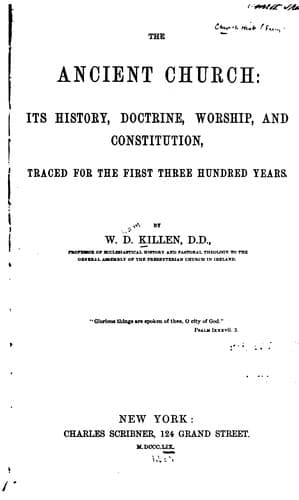
The Ancient Church: Its History, Doctrine, Worship, and ConstitutionKillen, W. D. (William Dool)
Religion
The Ancient Church: Its History, Doctrine, Worship, and Constitution
Killen, W. D. (William Dool)
Church history -- Primitive and early church, ca. 30-600
In the apostolic age we read likewise of elders and bishops; and in the
New Testament these names are often used interchangeably.[232:4] The
elders or bishops, were the same as the pastors and teachers; for they
had the charge of the instruction and government of the Church.[232:5]
Hence elders are required to act as faithful pastors under Christ, the
Chief Shepherd.[232:6] It appears, too, that whilst some of the elders
were only pastors, or rulers, others were also teachers. The apostle
says accordingly--"Let the elders that _rule_ well, be counted worthy of
double honour, especially those that _labour in the word and
doctrine_".[232:7] We may thus see that the teachers, governments, and
helps, mentioned by Paul when writing to the Corinthians, are the same
as the "bishops and deacons" of whom he speaks elsewhere. [233:1]
In primitive times there were, generally, a plurality of elders, as well
as a plurality of deacons, in every church or congregation; [233:2] and
each functionary was expected to apply himself to that particular
department of his office which he could manage most efficiently. Some
elders possessed a peculiar talent for expounding the gospel in the way
of preaching, or, as it was occasionally called, prophesying; [233:3]
others excelled in delivering hortatory addresses to the people; others
displayed great tact and sagacity in conducting ecclesiastical business,
or in dealing personally with offenders, or with penitents; whilst
others again were singularly successful in imparting private instruction
to catechumens. Some deacons were frequently commissioned to administer
to the wants of the sick; and others, who were remarkable for their
shrewdness and discrimination, were employed to distribute alms to the
indigent. In one of his epistles Paul pointedly refers to the multiform
duties of these ecclesiastical office-bearers-"Having then," says he,"
gifts, differing according to the grace that is given to us, whether
prophecy, let us prophesy according to the proportion of faith; or
ministry (of the deacon), let us wait on our ministering; or he that
teacheth, on teaching; or he that exhorteth, on exhortation; he that
giveth, let him do it with simplicity; he that ruleth, with diligence;
he that sheweth mercy, with cheerfulness." [233:4] It has been supposed
by some that all the primitive elders, or bishops, were preachers; but
the records of apostolic times warrant no such conclusion. These elders
were appointed simply to "take care of the Church of God;" [233:5] and
it was not necessary that each individual should perform all the
functions of the pastoral office. Even at the present day a single
preacher is generally sufficient to minister to a single congregation.
When Paul requires that the elders who rule well, though they may not
"labour in the word and doctrine," shall be counted worthy of double
honour, [234:1] is language distinctly indicates that there were then
Public-domain text, read in full here on John Shaqi.
Reviews
Reviews
No reviews yet
Be the first to share your thoughts on this work.
Elsewhere in the archive
Join the Discussion
Join the discussion
Sign in to leave a comment or review.
Sign InorCreate an account