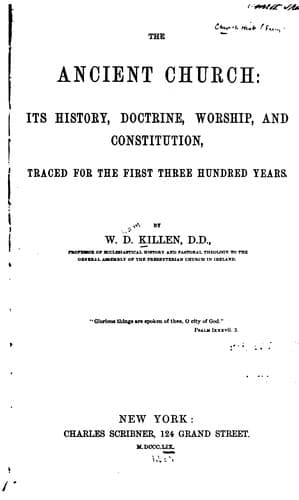
The Ancient Church: Its History, Doctrine, Worship, and ConstitutionKillen, W. D. (William Dool)
Religion
The Ancient Church: Its History, Doctrine, Worship, and Constitution
Killen, W. D. (William Dool)
Church history -- Primitive and early church, ca. 30-600
On the occasion of an ambitious request from James and John, our Lord
expounded to His apostles one of the great principles of His
ecclesiastical polity. "Jesus called them to him, and saith unto
them--Ye know that they which are accounted to rule over the Gentiles
exercise lordship over them; and their great ones exercise authority
upon them. _But so shall it not be among you_, but whosoever will be
great among you, shall be your minister, and whosoever of you will be
chiefest, shall be servant of all. For even the Son of man came not to
be ministered unto, but to minister, and to give his life a ransom for
many." [243:2] The teaching elder holds the most honourable position in
the Church, simply because his office is the most laborious, the most
responsible, and the most useful. And no minister of the Word is
warranted to exercise lordship over his brethren, for all are equally
the servants of the same Divine Master. He is the greatest who is most
willing to humble himself, to spend, and to be spent, that Christ may be
exalted. Even the Son of man came, not to be ministered unto, but to
minister; it was His meat and His drink to do the will of His Father in
heaven; He was ready to give instruction to many or to few; at the sea
or by the wayside; in the house, the synagogue, or the corn-field; on
the mountain or in the desert; when sitting in the company of publicans,
or when He had not where to lay His head. He who exhibits most of the
spirit and character of the Great Teacher is the most illustrious of
Christ's ministers.
The primitive Church was pre-eminently a free society; and, with a view
to united action, its members were taught to consult together respecting
all matters of common interest. Whilst the elders were required to
beware of attempting to domineer over each other, they were also warned
against deporting themselves as "lords over God's heritage." [244:1] All
were instructed to be courteous, forbearing, and conciliatory; and each
individual was made to understand that he possessed some importance.
Though the apostles, as inspired rulers of the Christian commonwealth,
might have done many things on their own authority, yet, even in
concerns comparatively trivial, as well as in affairs of the greatest
consequence, they were guided by the wishes of the people. When an
apostle was to be chosen in the place of Judas, the multitude were
consulted. [244:2] When deputies were required to accompany Paul in a
journey to be undertaken for the public service, the apostle did not
himself select his fellow-travellers, but the churches concerned,
proceeded, by a regular vote, to make the appointment. [244:3] When
deacons A or elders were to be nominated, the choice rested with the
congregation. [244:4] The records of the apostolic age do not mention
any ordinary church functionary who was not called to his office by
popular suffrage. [244:5]
Public-domain text, read in full here on John Shaqi.
Reviews
Reviews
No reviews yet
Be the first to share your thoughts on this work.
Elsewhere in the archive
Join the Discussion
Join the discussion
Sign in to leave a comment or review.
Sign InorCreate an account