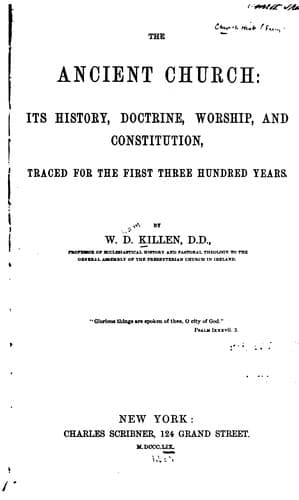
The Ancient Church: Its History, Doctrine, Worship, and ConstitutionKillen, W. D. (William Dool)
Religion
The Ancient Church: Its History, Doctrine, Worship, and Constitution
Killen, W. D. (William Dool)
Church history -- Primitive and early church, ca. 30-600
But though, in apostolic times, the communicants were thus freely
entrusted with the elective franchise, the constitution of the primitive
Church was not purely democratic; for while its office-bearers were
elected for life, and whilst its elders or bishops formed a species of
spiritual aristocracy, the powers of the people and the rulers were so
balanced as to check each other's aberrations, and to promote the
healthful action of all parts of the ecclesiastical body. When a deacon
or a bishop was elected, he was not permitted, without farther ceremony,
to enter upon the duties of his vocation. He was bound to submit himself
to the presbytery, that they might ratify the choice by ordination; and
this court, by refusing the imposition of hands, could protect the
Church against the intrusion of incompetent or unworthy candidates.
[245:1]
Among the Jews every ordained elder was considered qualified to join in
the ordination of others. [245:2] The same principle was acknowledged in
the early Christian Church; and when any functionary was elected, he was
introduced to his office by the presbytery of the city or district with
which he was connected. There is no instance in the apostolic age in
which ordination was conferred by a single individual, Paul and Barnabas
were separated to the work to which the Lord had called them by the
ministers of Antioch; [245:3] the first elders of the Christian Churches
of Asia Minor were set apart by Paul and Barnabas; [245:4] Timothy was
invested with ecclesiastical authority by "the laying on of the hands of
the presbytery;" [245:5] and even the seven deacons were ordained by the
twelve apostles acting, for the time, as the presbytery of Jerusalem.
[245:6]
Towards the conclusion of the Epistle to the Romans, [245:7] Paul
mentions Phoebe, "a servant [245:8] of the Church which is at Cenchrea;"
and from this passage some have inferred that the apostles instituted an
order of _deaconesses_. It is scarcely safe to build such an hypothesis
on the foundation of a solitary text of doubtful significance. It may be
that Phoebe was one of the poor widows supported by the Church; [246:1]
and that, as such, she was employed by the elders in various little
services of a confidential or benevolent character. It is probable that,
at one period, she had been in more comfortable circumstances, and that
she had then distinguished herself by her humane and obliging
disposition; for Paul refers apparently to this portion of her history
when he says, "she hath been a succourer of many, and of myself also."
[246:2]
Public-domain text, read in full here on John Shaqi.
Reviews
Reviews
No reviews yet
Be the first to share your thoughts on this work.
Elsewhere in the archive
Join the Discussion
Join the discussion
Sign in to leave a comment or review.
Sign InorCreate an account