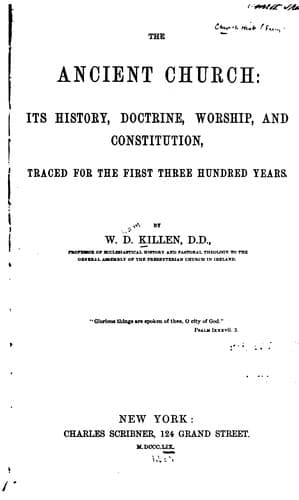
The Ancient Church: Its History, Doctrine, Worship, and ConstitutionKillen, W. D. (William Dool)
Religion
The Ancient Church: Its History, Doctrine, Worship, and Constitution
Killen, W. D. (William Dool)
Church history -- Primitive and early church, ca. 30-600
The Israelites were emphatically "a peculiar people." Though amounting,
in the days of our Lord, to several millions of individuals, they were
all the lineal descendants of Abraham; and though two thousand years had
passed away since the time of their great progenitor; they had not
meanwhile intermingled, to any considerable extent, with the rest of the
human family. The bulk of the nation still occupied the land which had
been granted by promise to the "father of the faithful;" the same farms
had been held by the same families from age to age; and probably some of
the proprietors could boast that their ancestors, fifteen hundred years
before, had taken possession of the very fields which they now
cultivated. They had all one form of worship, one high priest, and one
place of sacrifice. At stated seasons every year all the males of a
certain age were required to meet together at Jerusalem; and thus a full
representation of the whole race was frequently collected in one great
congregation.
The written law of Moses was the sacred bond which united so closely the
Church of Israel. The ritual observances of the Hebrews, which had all a
typical meaning, are described by the inspired lawgiver with singular
minuteness; and any deviation from them was forbidden, not only because
it involved an impeachment either of the authority or the wisdom of
Jehovah, but also because it was calculated to mar their significance.
Under the Mosaic economy the posterity of Abraham were taught to regard
each other as members of the same family, interested, as joint heirs, in
the blessings promised to their distinguished ancestor. The Israelites
were knit together by innumerable ties, as well secular as religious;
and when they appeared in one multitudinous assemblage on occasions of
peculiar solemnity, [249:1] they presented a specimen of ecclesiastical
unity such as the world has never since contemplated.
Public-domain text, read in full here on John Shaqi.
Reviews
Reviews
No reviews yet
Be the first to share your thoughts on this work.
Elsewhere in the archive
Join the Discussion
Join the discussion
Sign in to leave a comment or review.
Sign InorCreate an account