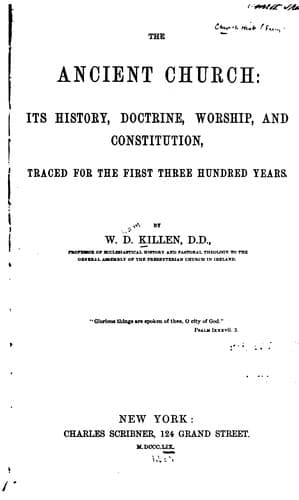
The Ancient Church: Its History, Doctrine, Worship, and ConstitutionKillen, W. D. (William Dool)
Religion
The Ancient Church: Its History, Doctrine, Worship, and Constitution
Killen, W. D. (William Dool)
Church history -- Primitive and early church, ca. 30-600
Some, however, have contended that the Christian community was
originally constructed upon very different principles. According to them
the word _church_ [249:2] in the New Testament is always used in one of
two senses--either as denoting a single worshipping society, or the
whole commonwealth of the faithful; and from this they infer that, in
primitive times, every Christian congregation was independent of every
other. But such allegations, which are exceedingly improbable in
themselves, are found, when carefully investigated, to be totally
destitute of foundation. The Church of Jerusalem, [249:3] with the tens
of thousands of individuals belonging to it, [249:4] must have consisted
of several congregations; [249:5] the Church of Antioch, to which so
many prophets and teachers ministered, [249:6] was probably in a similar
position; and the Church of Palestine [249:7] obviously comprehended a
large number of associated churches. When our Saviour prayed that all
His people "may be one," [250:1] He evidently indicated that the unity
of the Church, so strikingly exhibited in the nation of Israel, should
still be studied and maintained; and when Paul describes the household
of faith, he speaks of it, not as a loose mass of independent
congregations, but as a "body fitly _joined together and compacted_ by
that which every _joint_ supplieth." [250:2] The apostle here refers to
the vital union of believers by the indwelling of the Holy Ghost; but he
apparently alludes also to those "bands" of outward ordinances, and
"joints" [250:3] of visible confederation, by which their communion is
upheld; for, were the Church split up into an indefinite number of
insulated congregations, even the unity of the spirit could neither be
distinctly ascertained nor properly cultivated. When oiled by the spirit
of Divine love, the machinery of the Church moves with admirable
harmony, and accomplishes the most astonishing results; but, when
pervaded by another spirit, it is strained and dislocated, and in danger
of dashing itself to pieces.
Public-domain text, read in full here on John Shaqi.
Reviews
Reviews
No reviews yet
Be the first to share your thoughts on this work.
Elsewhere in the archive
Join the Discussion
Join the discussion
Sign in to leave a comment or review.
Sign InorCreate an account