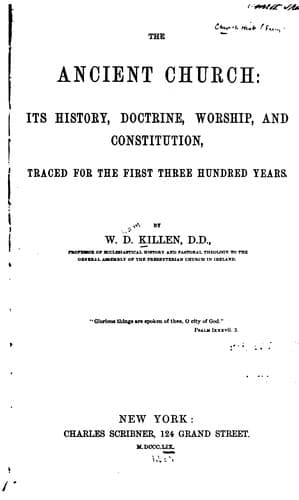
The Ancient Church: Its History, Doctrine, Worship, and ConstitutionKillen, W. D. (William Dool)
Religion
The Ancient Church: Its History, Doctrine, Worship, and Constitution
Killen, W. D. (William Dool)
Church history -- Primitive and early church, ca. 30-600
Those who hold that every congregation, however small, is a complete
church in itself, are quite unable to explain why the system of
ecclesiastical organization should be thus circumscribed. The New
Testament inculcates the unity of all the faithful, as well as the unity
of particular societies; and the same principle of Christian brotherhood
which prompts a number of individuals to meet together for religious
fellowship, should also lead a number of congregations in the same
locality to fraternize. The twelve may be regarded as the
representatives of the doctrine of ecclesiastical confederation; for
though they were commanded to go into all the world and to preach the
gospel to every creature, yet, as long as circumstances permitted, they
continued to co-operate. "When the apostles which were at Jerusalem
heard that Samaria had received the word of God, _they sent_ unto them
Peter and John;" [251:1] and, at a subsequent period, they concurred in
_sending "forth_ Barnabas, that he should go as far as Antioch." [251:2]
These facts distinctly prove that they had a common interest in
everything pertaining to the well-being of the whole Christian
commonwealth; and that, like Paul, they were entrusted with "the care of
all the churches." Nor did the early Christian congregations act
independently. They believed that union is strength, and they were "knit
together" in ecclesiastical relationship. Hence, we read of the brother
who was "chosen of the churches" [251:3] to travel with the Apostle
Paul. It is now impossible to determine in what way this choice was
made--whether at a general meeting of deputies from different
congregations, or by a separate vote in each particular society--but, in
whatever way the election was accomplished, the appointment of one
representative for several churches was itself a recognition of their
ecclesiastical unity.
Public-domain text, read in full here on John Shaqi.
Reviews
Reviews
No reviews yet
Be the first to share your thoughts on this work.
Elsewhere in the archive
Join the Discussion
Join the discussion
Sign in to leave a comment or review.
Sign InorCreate an account