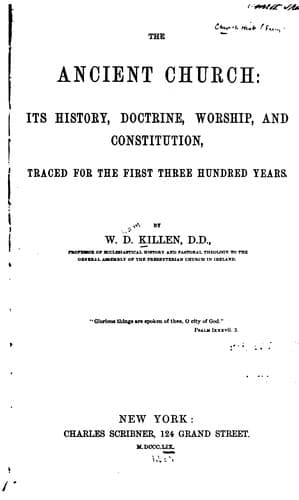
The Ancient Church: Its History, Doctrine, Worship, and ConstitutionKillen, W. D. (William Dool)
Religion
The Ancient Church: Its History, Doctrine, Worship, and Constitution
Killen, W. D. (William Dool)
Church history -- Primitive and early church, ca. 30-600
In the interval between the days of the apostles and the conversion of
Constantine, the Christian commonwealth changed its aspect. The Bishop
of Rome--a personage unknown to the writers of the New Testament--
meanwhile rose into prominence, and at length took precedence of
all other churchmen. Rites and ceremonies, of which neither Paul nor
Peter ever heard, crept silently into use, and then claimed the rank of
divine institutions. Officers, for whom the primitive disciples could
have found no place, and titles, which to them would have been
altogether unintelligible, began to challenge attention, and to be named
apostolic. It is the duty of the historian to endeavour to point out the
origin, and to trace the progress of these innovations. A satisfactory
account of them must go far to settle more than one of our present
controversies. An attempt is here made to lay bare the causes which
produced these changes, and to mark the stages of the ecclesiastical
revolution. When treating of the rise and growth of the hierarchy,
several remarkable facts and testimonies which have escaped the notice
of preceding historians are particularly noticed.
Some may, perhaps, consider that, in a work such as this, undue
prominence has been given to the discussion of the question of the
Ignatian epistles. Those who have carefully examined the subject will
scarcely think so. If we accredit these documents, the history of the
early Church is thrown into a state of hopeless confusion; and men,
taught and honoured by the apostles themselves, must have inculcated the
most dangerous errors. But if their claims vanish, when touched by the
wand of truthful criticism, many clouds which have hitherto darkened the
ecclesiastical atmosphere disappear; and the progress of corruption can
be traced on scientific principles. The special attention of all
interested in the Ignatian controversy is invited to the two chapters of
this work in which the subject is investigated. Evidence is there
produced to prove that these Ignatian letters, even as edited by the
very learned and laborious Doctor Cureton, are utterly spurious, and
that they should be swept away from among the genuine remains of early
Church literature with the besom of scorn.
Public-domain text, read in full here on John Shaqi.
Reviews
Reviews
No reviews yet
Be the first to share your thoughts on this work.
Join the Discussion
Join the discussion
Sign in to leave a comment or review.
Sign InorCreate an account