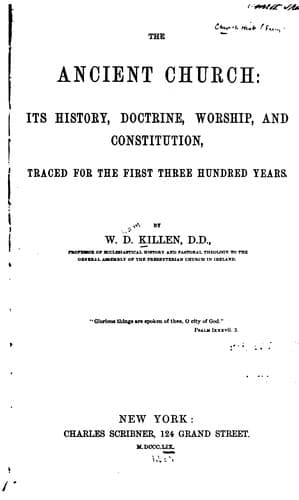
The Ancient Church: Its History, Doctrine, Worship, and ConstitutionKillen, W. D. (William Dool)
Religion
The Ancient Church: Its History, Doctrine, Worship, and Constitution
Killen, W. D. (William Dool)
Church history -- Primitive and early church, ca. 30-600
We form a most inadequate estimate of the trials of the early
Christians, if we take into account only those sufferings they endured
from the hands of the pagan magistrates. Circumstances which seldom came
under the eye of public observation not unfrequently kept them for life
in a state of disquietude. Idolatry was so interwoven with the very
texture of society that the adoption of the new faith sometimes abruptly
deprived an individual of the means of subsistence. If he was a
statuary, he could no longer employ himself in carving images of the
gods; if he was a painter, he could no more expend his skill in
decorating the high places of superstition. To earn a livelihood, he
must either seek out a new sphere for the exercise of his art, or betake
himself to some new occupation. If the Christian was a merchant, he was,
to a great extent, at the mercy of those with whom he transacted
business. When his property was in the hands of dishonest heathens, he
was often unable to recover it, as the pagan oaths administered in the
courts of justice prevented him from appealing for redress to the laws
of the empire. [287:1] Were he placed in circumstances which enabled him
to surmount this difficulty, he could not afford to exasperate his
debtors; as they could have so easily retaliated by accusing him of
Christianity. The wealthy disciple could not accept the office of a
magistrate, for he would have thus only betrayed his creed; neither
could he venture to aspire to any of the honours of the state, as his
promotion would most certainly have aggravated the perils of his
position. Our Saviour had said--"I am come to set a man at variance
against his father, and the daughter against her mother, and the
daughter-in-law against her mother-in-law; and a man's foes shall be
they of his own household." [287:2] These words were now verified with
such woeful accuracy that the distrust pervading the domestic circle
often imbittered the whole life of the believer. The slave informed
against his Christian master; the husband divorced his Christian wife;
and children who embraced the gospel were sometimes disinherited by
their enraged parents. [287:3] As the followers of the cross
contemplated the hardships which beset them on every side, well might
they have exclaimed in the words of the apostle--"If in this life only
we have hope in Christ, we are of all men most miserable." [287:4]
Public-domain text, read in full here on John Shaqi.
Reviews
Reviews
No reviews yet
Be the first to share your thoughts on this work.
Elsewhere in the archive
Join the Discussion
Join the discussion
Sign in to leave a comment or review.
Sign InorCreate an account