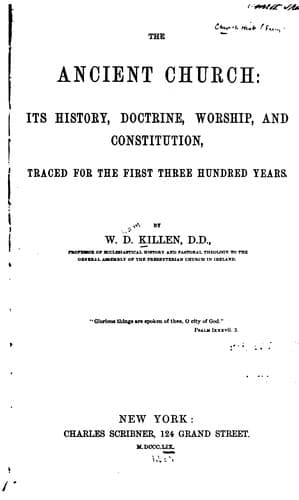
The Ancient Church: Its History, Doctrine, Worship, and ConstitutionKillen, W. D. (William Dool)
Religion
The Ancient Church: Its History, Doctrine, Worship, and Constitution
Killen, W. D. (William Dool)
Church history -- Primitive and early church, ca. 30-600
Under the brutal and bloody Commodus, the son and heir of Marcus
Aurelius, the Christians had some repose. Marcia, his favourite
concubine, was a member of the Church; [296:2] and her influence was
successfully exerted in protecting her co-religionists. But the penal
statutes were still in force, and they were not everywhere permitted to
remain a dead letter. In this reign [296:3] we meet with some of the
earliest indications of that zeal for martyrdom which was properly the
spawn of the fanaticism of the Montanists. In a certain district of
Asia, a multitude of persons, actuated by this absurd passion, presented
themselves in a body before the proconsul Arrius Antoninus; and
proclaimed themselves Christians. The sight of such a crowd of victims
appalled the magistrate; and, after passing judgment on a few, he is
said to have driven the remainder from his tribunal, exclaiming--
"Miserable men, if you wish to kill yourselves, you have ropes or
precipices."
The reigns of Pertinax and Julian, the Emperors next in succession after
Commodus, amounted together only to a few months; and the faithful had
meanwhile to struggle with many discouragements; [296:4] but these
short-lived sovereigns were so much occupied with other matters, that
they could not afford time for legislation on the subject of religion.
Septimius Severus, who now obtained the Imperial dignity, was at first
not unfriendly to the Church; and a cure performed on him by Proculus, a
Christian slave, [297:1] has been assigned as the cause of his
forbearance; but, as his reign advanced, he assumed an offensive
attitude; and it cannot be denied that the disciples suffered
considerably under his administration. As the Christians were still
obliged to meet at night to celebrate their worship, they were accused
of committing unnatural crimes in their nocturnal assemblies; and though
these heartless calumnies had been triumphantly refuted fifty or sixty
years before, they were now revived and circulated with fresh industry.
[297:2] About this period, Leonides, the father of the learned Origen,
was put to death. By a law, promulgated probably in A.D. 202, the
Emperor interdicted conversions to Christianity; and at a time when the
Church was making vigorous encroachments on heathenism, this enactment
created much embarrassment and anxiety. Some of the governors of
provinces, as soon as they ascertained the disposition of the Imperial
court, commenced forthwith a persecution; and there were magistrates who
proceeded to enforce the laws for the base purpose of extorting money
from the parties obnoxious to their severity. Sometimes individuals, and
sometimes whole congregations purchased immunity from suffering by
entering into pecuniary contracts with corrupt and avaricious rulers;
and by the payment of a certain sum obtained certificates [297:3] which
protected them from all farther inquisition. [297:4] The purport of
these documents has been the subject of much discussion. According to
Public-domain text, read in full here on John Shaqi.
Reviews
Reviews
No reviews yet
Be the first to share your thoughts on this work.
Elsewhere in the archive
Join the Discussion
Join the discussion
Sign in to leave a comment or review.
Sign InorCreate an account