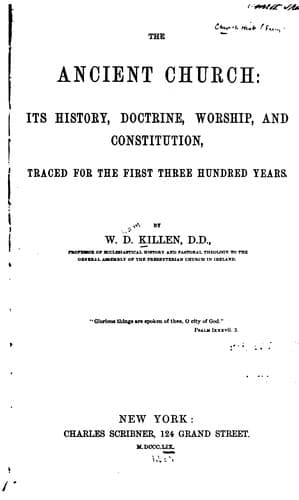
The Ancient Church: Its History, Doctrine, Worship, and ConstitutionKillen, W. D. (William Dool)
Religion
The Ancient Church: Its History, Doctrine, Worship, and Constitution
Killen, W. D. (William Dool)
Church history -- Primitive and early church, ca. 30-600
some they contained a distinct statement to the effect that those named
in them had sacrificed to the gods, and had thus satisfied the law;
whilst others allege that, though they guaranteed protection, they
neither directly stated an untruth, nor compromised the religious
consistency of their possessors. But it is beyond all controversy that
the more scrupulous and zealous Christians uniformly condemned the use
of such certificates. Their owners were known by the suspicious
designation of "Libellatici," or "the Certified;" and were considered
only less criminal than the "Thurificati," or those who had actually
apostatised by offering incense on the altars of paganism. [298:1]
About this time the enforcement of the penal laws in a part of North
Africa, probably in Carthage, led to a most impressive display of some
of the noblest features of the Christian character. Five catechumens, or
candidates for baptism, among whom were Perpetua and Felicitas, [298:2]
had been put under arrest. Perpetua, who was only two and twenty years
of age, was a lady of rank and of singularly prepossessing appearance.
Accustomed to all the comforts which wealth could procure, she was ill
fitted, with a child at the breast, to sustain the rigours of
confinement--more especially as she was thrown into a crowded dungeon
during the oppressive heat of an African summer. But, with her infant in
her arms, she cheerfully submitted to her privations; and the thought
that she was persecuted for Christ's sake, converted her prison into a
palace. Her aged father, who was a pagan, was overwhelmed with distress
because, as he conceived, she was bringing deep and lasting disgrace
upon her family by her attachment to a proscribed sect; and as she was
his favourite child, he employed every expedient which paternal
tenderness and anxiety could dictate to lead her to a recantation. When
she was conducted to the judgment-seat with the other prisoners, the old
gentleman appeared there, to try the effect of another appeal to her;
and the presiding magistrate, touched with pity, entreated her to listen
to his arguments, and to change her resolution. But, though deeply moved
by the anguish of her aged parent, all these attempts to shake her
constancy were in vain. At the place of execution she sung a psalm of
victory, and, before she expired, she exhorted her brother and another
catechumen, named Rusticus, to continue in the faith, to love each
other, and to be neither affrighted nor offended by her sufferings. Her
companion Felicitas exhibited quite as illustrious a specimen of
Christian heroism. When arrested, she was far advanced in pregnancy, and
during her imprisonment, the pains of labour came upon her. Her cries
arrested the attention of the jailer, who said to her--"If your present
sufferings are so great, what will you do when you are thrown to the
wild beasts? You did not consider this when you refused to sacrifice."
Public-domain text, read in full here on John Shaqi.
Reviews
Reviews
No reviews yet
Be the first to share your thoughts on this work.
Elsewhere in the archive
Join the Discussion
Join the discussion
Sign in to leave a comment or review.
Sign InorCreate an account