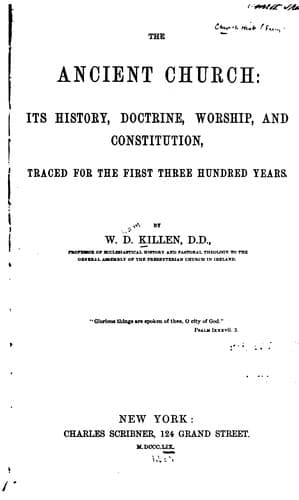
The Ancient Church: Its History, Doctrine, Worship, and ConstitutionKillen, W. D. (William Dool)
Religion
The Ancient Church: Its History, Doctrine, Worship, and Constitution
Killen, W. D. (William Dool)
Church history -- Primitive and early church, ca. 30-600
With undaunted spirit Felicitas replied--"It is _I_ that suffer _now_,
but _then_ there will be Another with me, who will suffer for me,
because I shall suffer for His sake." The prisoners were condemned to be
torn by wild beasts on the occasion of an approaching festival; and when
they had passed through this terrible ordeal, they were despatched with
the sword.
After the death of Septimius Severus, the Christians experienced some
abatement of their sufferings. Caracalla and Elagabalus permitted them
to remain almost undisturbed; and Alexander Severus has been supposed by
some to have been himself a believer. Among the images in his private
chapel was a representation of Christ, and he was obviously convinced
that Jesus possessed divine endowments; but there is no proof that he
ever accepted unreservedly the New Testament revelation. He was simply
an eclectic philosopher who held that a portion of truth was to be found
in each of the current systems of religion; and who undertook to analyse
them, and extract the spiritual treasure. The Emperor Maximin was less
friendly to the Church; and yet his enmity was confined chiefly to those
Christian ministers who had been favourites with his predecessor; so
that he cannot be said to have promoted any general persecution. Under
Gordian the disciples were free from molestation; and his successor,
Philip the Arabian, was so well affected to their cause that he has been
sometimes, though erroneously, represented as the first Christian
Emperor. [300:1] The death of this monarch in A.D. 249 was, however,
soon followed by the fiercest and the most extensive persecution under
which the faithful had yet groaned. The more zealous of the pagans, who
had been long witnessing with impatience the growth of Christianity, had
become convinced that, if the old religion were to be upheld, a mighty
effort must very soon be made to strangle its rival. Various expedients
were meanwhile employed to prejudice the multitude against the gospel.
Every disaster which occurred throughout the Empire was attributed to
its evil influence; the defeat of a general, the failure of a harvest,
the overflowing of the Tiber, the desolations of a hurricane, and the
appearance of a pestilence, were all ascribed to its most inauspicious
advancement. The public mind was thus gradually prepared for measures of
extreme severity; and Decius, who now became emperor, aimed at the utter
extirpation of Christianity. All persons suspected of attachment to the
gospel were summoned before the civil authorities; and if, regardless of
intimidation, they refused to sacrifice, attempts were made to overcome
their constancy by torture, by imprisonment, and by starvation. When all
such expedients failed, the punishment of death was inflicted. Those who
fled before the day appointed for their appearance in presence of the
magistrates, forfeited their property; and were forbidden, under the
penalty of death, to return to the district. The Church in many places
Public-domain text, read in full here on John Shaqi.
Reviews
Reviews
No reviews yet
Be the first to share your thoughts on this work.
Elsewhere in the archive
Join the Discussion
Join the discussion
Sign in to leave a comment or review.
Sign InorCreate an account