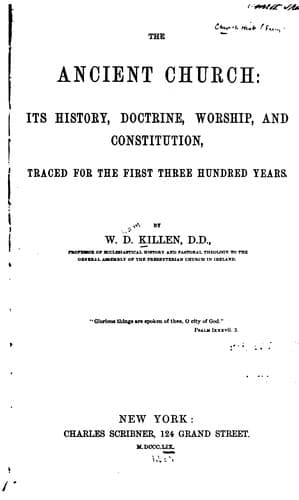
The Ancient Church: Its History, Doctrine, Worship, and ConstitutionKillen, W. D. (William Dool)
Religion
The Ancient Church: Its History, Doctrine, Worship, and Constitution
Killen, W. D. (William Dool)
Church history -- Primitive and early church, ca. 30-600
to be burned; requiring those who held offices of honour and emolument
to renounce their principles on pain of the forfeiture of their
appointments; declaring that disciples in the humbler walks of life, who
remained steadfast, should be divested of their rights as citizens and
free-men; and providing that even slaves, so long as they continued
Christians, should be incapable of manumission. [304:2] Some time
afterwards another edict was promulgated directing that all
ecclesiastics should be seized and put in chains. When the jails were
thus filled with Christian ministers, another edict made its appearance,
commanding that the prisoners should by all means be compelled to
sacrifice. At length a fourth edict, of a still more sweeping character
and extending to the whole body of Christians, was published. In
accordance with this decree proclamation was made throughout the streets
of the cities, and men, women, and children, were enjoined to repair to
the heathen temples. The city gates were guarded that none might escape;
and, from lists previously prepared, every individual was summoned by
name to present himself, and join in the performance of the rites of
paganism. [305:1] At a subsequent period all provisions sold in the
markets, in some parts of the empire, were sprinkled with the water or
the wine employed in idolatrous worship, that the Christians might
either be compelled to abstinence, or led to defile themselves by the
use of polluted viands. [305:2]
Throughout almost the whole Church the latter part of the third century
was a period of spiritual decay; and many returned to heathenism during
the sifting time which now followed. Not a few incurred the reproach of
their more consistent and courageous brethren by surrendering the
Scriptures in their possession; and those who thus purchased their
safety were stigmatised with the odious name of _traditors_. Had the
persecutors succeeded in burning all the copies of the Word of God, they
would, without the intervention of a miracle, have effectually secured
the ruin of the Church; but their efforts to destroy the sacred volume
proved abortive; for the faithful seized the earliest opportunity of
replacing the consumed manuscripts. The holy book was prized by them
more highly than ever, and Bible burning only gave a stimulus to Bible
transcription. Still, however, sacred literature sustained a loss of no
ordinary magnitude in this wholesale destruction of the inspired
writings, and there is not at present in existence a single codex of the
New Testament of higher antiquity than the Diocletian persecution.
[305:3]
Public-domain text, read in full here on John Shaqi.
Reviews
Reviews
No reviews yet
Be the first to share your thoughts on this work.
Elsewhere in the archive
Join the Discussion
Join the discussion
Sign in to leave a comment or review.
Sign InorCreate an account