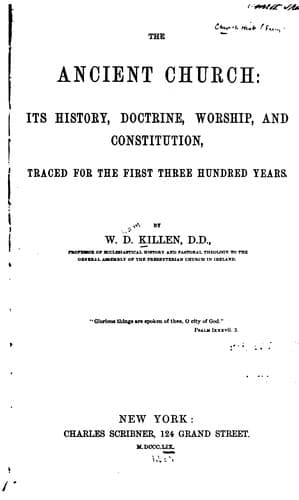
The Ancient Church: Its History, Doctrine, Worship, and ConstitutionKillen, W. D. (William Dool)
Religion
The Ancient Church: Its History, Doctrine, Worship, and Constitution
Killen, W. D. (William Dool)
Church history -- Primitive and early church, ca. 30-600
It has been computed that a greater number of Christians perished under
Decius than in all the attacks which had previously been made upon them;
but their sufferings under Diocletian were still more formidable and
disastrous. Paganism felt that it was now engaged in a death struggle;
and this, its last effort to maintain its ascendency, was its most
protracted and desperate conflict. It has been frequently stated that
the Diocletian persecution was of ten years' duration; and, reckoning
from the first indications of hostility to the promulgation of an edict
of toleration, it may certainly be thus estimated; but all this time the
whole Church was not groaning under the pressure of the infliction. The
Christians of the west of Europe suffered comparatively little; as there
the Emperor Constantius Chlorus, and afterwards his son Constantine, to
a great extent, preserved them from molestation. In the East they passed
through terrific scenes of suffering; for Galerius and Maximin, the two
stern tyrants who governed that part of the empire on the abdication of
Diocletian, endeavoured to overcome their steadfastness by all the
expedients which despotic cruelty could suggest. A contemporary, who had
access to the best sources of information, has given a faithful account
of the torments they endured. Vinegar mixed with salt was poured on the
lacerated bodies of the dying; some were roasted on huge gridirons;
some, suspended aloft by one hand, were then left to perish in
excruciating agony; and some, bound to parts of different trees which
had been brought together by machinery, were torn limb from limb by the
sudden revulsion of the liberated branches. [306:1] But, even in the
East, this attempt to overwhelm Christianity was not prosecuted from its
commencement to its close with unabated severity. Sometimes the
sufferers obtained a respite; and again, the work of blood was resumed
with fresh vigour. Though many were tempted for a season to make a
hollow profession of paganism, multitudes met every effort to seduce
them in a spirit of indomitable resolution. At length tyranny became
weary of its barren office, and the Church obtained peace. In A.D. 311,
Galerius, languishing under a loathsome disease, and perhaps hoping that
he might be relieved by the God of the Christians, granted them
toleration. Maximin subsequently renewed the attacks upon them; but at
his death, which occurred in A.D. 313, the edict in favour of the
Church, which Constantine and his colleague Licinius had already
published, became law throughout the empire.
Public-domain text, read in full here on John Shaqi.
Reviews
Reviews
No reviews yet
Be the first to share your thoughts on this work.
Elsewhere in the archive
Join the Discussion
Join the discussion
Sign in to leave a comment or review.
Sign InorCreate an account