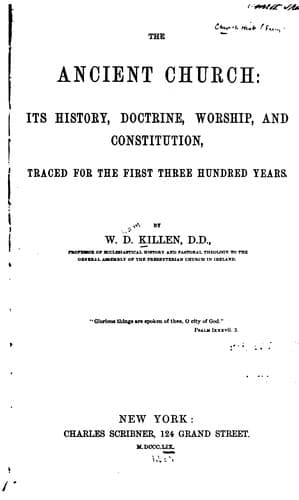
The Ancient Church: Its History, Doctrine, Worship, and ConstitutionKillen, W. D. (William Dool)
Religion
The Ancient Church: Its History, Doctrine, Worship, and Constitution
Killen, W. D. (William Dool)
Church history -- Primitive and early church, ca. 30-600
It might have been expected that the sore oppression which the Church
endured for so many generations would have indelibly imprinted on the
hearts of her children the doctrine of liberty of conscience. As the
early Christians expostulated with their pagan rulers, they often
described most eloquently the folly of persecution. "How unjust is it,"
said they, "that freemen should be driven to sacrifice to the gods, when
in all other instances a willing mind is required as an indispensable
qualification for any office of religion?" [310:1] "It appertains to
man's proper right and natural privilege that each should worship that
which he thinks to be God....Neither is it the part of religion to
compel men to religion, which ought to be adopted voluntarily, not of
compulsion, seeing that sacrifices are required of a willing mind. Thus,
even if you compel us to sacrifice, you shall render no sacrifice
thereby to your gods, for they will not desire sacrifices from unwilling
givers, unless they are contentious; but God is not contentious."
[310:2] When, however, the Church obtained possession of the throne of
the empire, she soon ignored these lessons of toleration; and, snatching
the weapons of her tormentors, she attempted, in her turn, to subjugate
the soul by the dungeon, the sword, and the faggot. For at least
thirteen centuries after the establishment of Christianity by
Constantine, it was taken for granted almost everywhere that those
branded with the odious name of heretics were unworthy the protection of
the laws; and that, though good and loyal citizens, they ought to be
punished by the civil magistrate. This doctrine, so alien to the spirit
of the New Testament, has often spread desolation and terror throughout
whole provinces; and has led to the deliberate murder of a hundredfold
more Christians than were destroyed by pagan Rome. Even the fathers of
the Reformation did not escape from the influence of an intolerant
training; but that Bible which they brought forth from obscurity has
been gradually imparting a milder tone to earthly legislation; and
various providences have been illustrating the true meaning of the
proposition that Christ's kingdom is "not of this world." [311:1] In all
free countries it is now generally admitted that the weapons of the
Church are not carnal, and that the jurisdiction of the magistrate is
not spiritual. "God alone is Lord of the conscience;" and it is only by
the illumination of His Word that the monitor within can be led to
recognise His will, and submit to His authority.
CHAPTER III.
FALSE BRETHREN AND FALSE PRINCIPLES IN THE CHURCH: SPIRIT AND CHARACTER
OF THE CHRISTIANS.
Public-domain text, read in full here on John Shaqi.
Reviews
Reviews
No reviews yet
Be the first to share your thoughts on this work.
Elsewhere in the archive
Join the Discussion
Join the discussion
Sign in to leave a comment or review.
Sign InorCreate an account