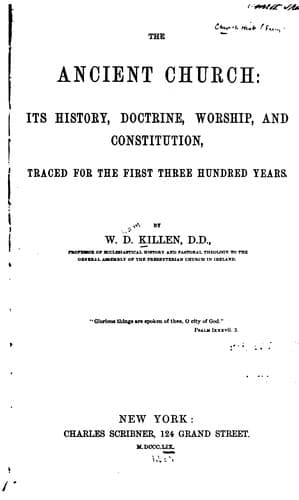
The Ancient Church: Its History, Doctrine, Worship, and ConstitutionKillen, W. D. (William Dool)
Religion
The Ancient Church: Its History, Doctrine, Worship, and Constitution
Killen, W. D. (William Dool)
Church history -- Primitive and early church, ca. 30-600
Some have an idea that the saintship of the early Christians was of a
type altogether unique and transcendental. In primitive times the Spirit
was, no doubt, poured out in rich effusion, and the subjects of His
grace, when contrasted with the heathen around them, often exhibited
most attractively the beauty of holiness; but the same Spirit still
dwells in the hearts of the faithful, and He is now as able, as He ever
was, to enlighten and to save. As man, wherever he exists, possesses
substantially the same organic conformation, so the true children of
God, to whatever generation they belong, have the same divine
lineaments. The age of miracles has passed away, but the reign of grace
continues, and, at the present day, there may, perhaps, be found amongst
the members of the Church as noble examples of vital godliness as in the
first or second century.
There was a traitor among the Twelve, and it is apparent from the New
Testament that, in the Apostolic Church, there were not a few unworthy
members. "_Many_ walk," says Paul, "of whom I have told you often, and
now tell you, even weeping, that they are the enemies of the cross of
Christ, whose end is destruction, whose god is their belly, and whose
glory is in their shame, who mind earthly things." [312:1] In the second
and third centuries the number of such false brethren did not diminish.
To those who are ignorant of its saving power, Christianity may commend
itself, by its external evidences, as a revelation from God; and many,
who are not prepared to submit to its authority, may seek admission to
its privileges. The superficial character of much of the evangelism now
current appeared in times of persecution; for, on the first appearance
of danger, multitudes abjured the gospel, and returned to the heathen
superstitions. It is, besides, a fact which cannot be disputed that, in
the third century, the more zealous champions of the faith felt it
necessary to denounce the secularity of many of the ministers of the
Church. Before the Decian persecution not a few of the bishops were mere
worldlings, and such was their zeal for money-making, that they left
their parishes neglected, and travelled to remote districts where, at
certain seasons of the year, they might carry on a profitable traffic
[313:1]. If we are to believe the testimony of the most distinguished
ecclesiastics of the period, crimes were then perpetrated to which it
would be difficult to find anything like parallels in the darkest pages
of the history of modern Christianity. The chief pastor of the largest
Church in the Proconsular Africa tells, for instance, of one of his own
presbyters who robbed orphans and defrauded widows, who permitted his
father to die of hunger and treated his pregnant wife with horrid
brutality. [313:2] Another ecclesiastic, of still higher position,
speaks of three bishops in his neighbourhood who engaged, when
intoxicated, in the solemn rite of ordination. [313:3] Such excesses
Public-domain text, read in full here on John Shaqi.
Reviews
Reviews
No reviews yet
Be the first to share your thoughts on this work.
Elsewhere in the archive
Join the Discussion
Join the discussion
Sign in to leave a comment or review.
Sign InorCreate an account