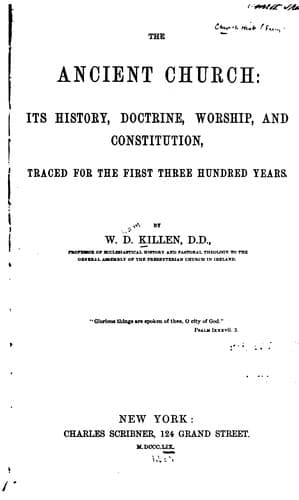
The Ancient Church: Its History, Doctrine, Worship, and ConstitutionKillen, W. D. (William Dool)
Religion
The Ancient Church: Its History, Doctrine, Worship, and Constitution
Killen, W. D. (William Dool)
Church history -- Primitive and early church, ca. 30-600
About the time that the advocates of "whatsoever things are of good
report" were protesting against the improprieties of these spiritual
brethren and sisters, Paul and Antony, the fathers and founders of
Monachism, commenced to live as hermits. Paul was a native of Egypt, and
the heir of a considerable fortune; but, driven at first by persecution
from the abodes of men, he ultimately adopted the desert as the place of
his chosen residence. Antony, in another part of the same country,
guided by a mistaken spirit of self-renunciation, divested himself of
all his property; and also retired into a wilderness. The biographies of
these two well-meaning but weak-minded visionaries, which have been
written by two of the most eminent divines of the fourth century,
[316:1] are very humiliating memorials of folly and fanaticism. These
solitaries spent each a long life in a cave, macerating the body with
fasting, and occupying the mind with the reveries of a morbid
imagination. In an age of growing superstition their dreamy pietism was
mistaken by many for sanctity of uncommon excellence; and the admiration
bestowed on them, tempted others, in the beginning of the following
century, to imitate their example. Soon afterwards, societies of these
sons of the desert were established; and, in the course of a few years,
a taste for the monastic life spread, like wild-fire, over the whole
Church.
It is a curious fact that the figure of the instrument of torture on
which our Lord was put to death, occupied a prominent place among the
symbols of the ancient heathen worship. From the most remote antiquity
the cross was venerated in Egypt and Syria; it was held in equal honour
by the Buddhists of the East, [316:2] and, what is still more
extraordinary, when the Spaniards first visited America, the well-known
sign was found among the objects of worship in the idol temples of
Anahuac. [316:3] It is also remarkable that, about the commencement of
our era, the pagans were wont to make the sign of a cross upon the
forehead in the celebration of some of their sacred mysteries. [317:1] A
satisfactory explanation of the origin of such peculiarities in the
ritual of idolatry can now scarcely be expected; but it certainly need
not excite surprise if the early Christians were impressed by them, and
if they viewed them as so many unintentional testimonies to the truth of
their religion. The disciples displayed, indeed, no little ingenuity in
their attempts to discover the figure of a cross in almost every object
around them. They could recognise it in the trees and the flowers, in
the fishes and the fowls, in the sails of a ship and the structure of
the human body; [317:2] and if they borrowed from their heathen
neighbours the custom of making a cross upon the forehead, they would of
course be ready to maintain that they thus only redeemed the holy sign
from profanation. Some of them were, perhaps, prepared, on prudential
grounds, to plead for its introduction.
Public-domain text, read in full here on John Shaqi.
Reviews
Reviews
No reviews yet
Be the first to share your thoughts on this work.
Elsewhere in the archive
Join the Discussion
Join the discussion
Sign in to leave a comment or review.
Sign InorCreate an account