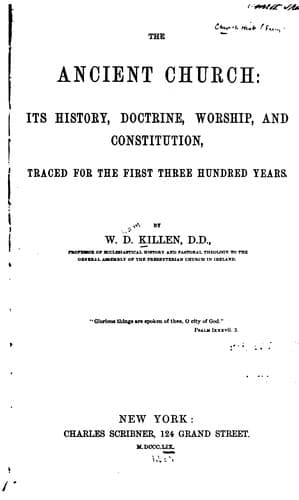
The Ancient Church: Its History, Doctrine, Worship, and ConstitutionKillen, W. D. (William Dool)
Religion
The Ancient Church: Its History, Doctrine, Worship, and Constitution
Killen, W. D. (William Dool)
Church history -- Primitive and early church, ca. 30-600
were indignantly condemned by all right-hearted disciples, but the fact,
that those to whom they were imputed were not destitute of partisans,
supplies clear yet melancholy proof that neither the Christian people
nor the Christian ministry, even in the third century, possessed an
unsullied reputation.
Meanwhile the introduction of a false standard of piety created much
mischief. It had long been received as a maxim, among certain classes of
philosophers, that bodily abstinence is necessary to those who would
attain more exalted wisdom; and the Gentile theology, especially in
Egypt and the East, had endorsed the principle. It was not without
advocates among the Jews, as is apparent from the discipline of the
Essenes and the Therapeutae. At an early period its influence was felt
within the pale of the Church, and before the termination of the second
century, individual members here and there were to be found who eschewed
certain kinds of food and abstained from marriage. [314:1] The pagan
literati, who now joined the disciples in considerable numbers, did much
to promote the credit of this adulterated Christianity. Its votaries,
who were designated _ascetics_ and _philosophers_ [314:2] did not
withdraw themselves from the world, but, whilst adhering to their own
regimen, still remained mindful of their social obligations. Their
self-imposed mortification soon found admirers, and an opinion gradually
gained ground that these abstinent disciples cultivated a higher form of
piety. The adherents of the new discipline silently increased, and by
the middle of the third century, a class of females who led a single
life, and who, by way of distinction, were called virgins, were in some
places regarded by the other Church members with special veneration.
[314:3] Among the clergy also celibacy was now considered a mark of
superior holiness. [314:4] But, in various places, pietism about this
time assumed a form which disgusted all persons of sober judgment and
ordinary discretion. The unmarried clergy and the virgins deemed it
right to cultivate the communion of saints after a new fashion, alleging
that, in each other's society, they enjoyed peculiar advantages for
spiritual improvement. It was not, therefore, uncommon to find a single
ecclesiastic and one of the sisterhood of virgins dwelling in the same
house and sharing the same bed! [315:1] All the while the parties
repudiated the imputation of any improper intercourse, but in some cases
the proofs of profligacy were too plain to be concealed, and common
sense refused to credit the pretensions of such an absurd and suspicious
spiritualism. The ecclesiastical authorities felt it necessary to
interfere, and compel the professed virgins and the single clergy to
abstain from a degree of intimacy which was unquestionably not free from
the appearance of evil.
Public-domain text, read in full here on John Shaqi.
Reviews
Reviews
No reviews yet
Be the first to share your thoughts on this work.
Elsewhere in the archive
Join the Discussion
Join the discussion
Sign in to leave a comment or review.
Sign InorCreate an account