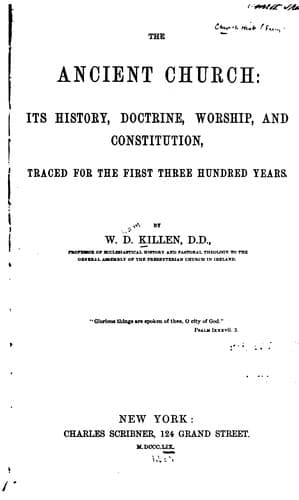
The Ancient Church: Its History, Doctrine, Worship, and ConstitutionKillen, W. D. (William Dool)
Religion
The Ancient Church: Its History, Doctrine, Worship, and Constitution
Killen, W. D. (William Dool)
Church history -- Primitive and early church, ca. 30-600
some other object of an emblematical character. [319:2] "We must not,"
said they, "cling to the sensuous but rise to the spiritual. The
familiarity of daily sight lowers the dignity of the divine, and to
pretend to worship a spiritual essence through earthly matter, is to
degrade that essence to the world of sense." [319:3] Even so late as the
beginning of the fourth century the practice of displaying paintings in
places of worship was prohibited by ecclesiastical authority. A canon
which bears upon this subject, and which was enacted by the Council of
Elvira held about A.D. 305, is more creditable to the pious zeal than to
the literary ability of the assembled fathers. "We must not," said they,
"have pictures in the church, lest that which is worshipped and adored
be painted on the walls." [320:1]
It has been objected to the Great Reformation of the sixteenth century
that it exercised a prejudicial influence on the arts of painting and
statuary. The same argument might have been urged against the gospel
itself in the days of its original promulgation. Whilst the early Church
entirely discarded the use of images in worship, its more zealous
members looked with suspicion upon all who assisted in the fabrication
of these objects of the heathen idolatry. [320:2] The excuse that the
artists were labouring for subsistence, and that they had themselves no
idea of bowing down to the works of their own hands, did not by any
means satisfy the scruples of their more consistent and conscientious
brethren. "Assuredly," they exclaimed, "you are a worshipper of idols
when you help to promote their worship. It is true you bring to them no
outward victim, but you sacrifice to them, your mind. Your sweat is
their drink-offering. You kindle for them the light of your skill."
[320:3] By denouncing image-worship the early Church, no doubt, to some
extent interfered with the profits of the painter and the sculptor; but,
in another way, it did much to purify and elevate the taste of the
public. In the second and third centuries the playhouse in every large
town was a centre of attraction; and whilst the actors were generally
persons of very loose morals, their dramatic performances were
perpetually pandering to the depraved appetites of the age. It is not,
therefore, wonderful that all true Christians viewed the theatre with
disgust. Its frivolity was offensive to their grave temperament; they
recoiled from its obscenity; and its constant appeals to the gods and
goddesses of heathenism outraged their religious convictions. [321:1] In
their estimation, the talent devoted to its maintenance was miserably
prostituted; and whilst every actor was deemed unworthy of
ecclesiastical fellowship, every church member was prohibited, by
attendance or otherwise, from giving any encouragement to the stage. The
early Christians were also forbidden to frequent the public shows, as
they were considered scenes of temptation and pollution. Every one at
Public-domain text, read in full here on John Shaqi.
Reviews
Reviews
No reviews yet
Be the first to share your thoughts on this work.
Elsewhere in the archive
Join the Discussion
Join the discussion
Sign in to leave a comment or review.
Sign InorCreate an account