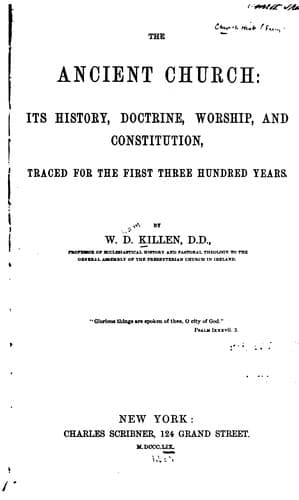
The Ancient Church: Its History, Doctrine, Worship, and ConstitutionKillen, W. D. (William Dool)
Religion
The Ancient Church: Its History, Doctrine, Worship, and Constitution
Killen, W. D. (William Dool)
Church history -- Primitive and early church, ca. 30-600
his baptism was required to renounce "the devil, his pomp, and his
angels" [321:2]--a declaration which implied that he was henceforth to
absent himself from the heathen spectacles. At this time, statesmen,
poets, and philosophers were not ashamed to appear among the crowds who
assembled to witness the combats of the gladiators, though, on such
occasions, human life was recklessly sacrificed. But here the Church,
composed chiefly of the poor of this world, was continually giving
lessons in humanity to heathen legislators and literati. It protested
against cruelty, as well to the brute creation as to man; and condemned
the taste which could derive gratification from the shedding of the
blood either of lions or of gladiators. All who sanctioned by their
presence the sanguinary sports of the amphitheatre incurred a sentence
of excommunication. [322:1]
At this time, though an increasing taste for inactivity and solitude
betokened the growth of a bastard Christianity, and though various other
circumstances were indicative of tendencies to adulterate religion,
either by reducing it to a system of formalism, or by sublimating it
into a life of empty contemplation, there were still abundant proofs of
the existence of a large amount of healthy and vigorous piety. The
members of the Church, as a body, were distinguished by their exemplary
morals; and about the beginning of the third century, one of their
advocates, when pleading for their toleration, could venture to assert
that, among the numberless culprits brought under the notice of the
magistrates, none were Christians. [322:2] Wherever the gospel spread,
its social influence was most salutary. Its first teachers applied
themselves discreetly to the redress of prevalent abuses; and time
gradually demonstrated the effectiveness of their plans of reformation.
When they appeared, polygamy was common; [322:3] and had they assailed
it in terms of unmeasured severity, they would have defeated their own
object by rousing up a most formidable and exasperated opposition. It
would have been argued by the Jews that they were reflecting on the
patriarchs; and it would have been said by the Roman governors that they
were interfering with matters which belonged to the province of the
civil magistrate. They were obliged, therefore, to proceed with extreme
caution. In the first place, they laid it down as a principle that every
bishop and deacon must be "the husband of one wife," [323:1] or, in
other words, that no polygamist could hold office in their society. They
thus, in the most pointed way, inculcated sound views respecting the
institution of marriage; for they intimated that whoever was the husband
of more than one wife was not, in every respect, "a pattern of good
works," and was consequently unfit for ecclesiastical promotion. In the
second place, in all their discourses they proceeded on the assumption
that the union of one man and one woman is the divine arrangement.
Public-domain text, read in full here on John Shaqi.
Reviews
Reviews
No reviews yet
Be the first to share your thoughts on this work.
Elsewhere in the archive
Join the Discussion
Join the discussion
Sign in to leave a comment or review.
Sign InorCreate an account