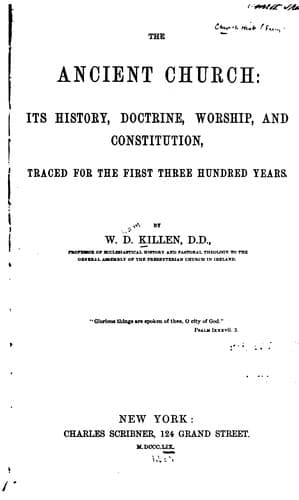
The Ancient Church: Its History, Doctrine, Worship, and ConstitutionKillen, W. D. (William Dool)
Religion
The Ancient Church: Its History, Doctrine, Worship, and Constitution
Killen, W. D. (William Dool)
Church history -- Primitive and early church, ca. 30-600
The primitive heralds of the gospel acted with remarkable prudence in
reference to the question of slavery. According to some high
authorities, bondsmen constituted one-half [324:2] of the entire
population of the Roman Empire; and as the new religion was designed to
promote the spiritual good of man, rather than the improvement of his
civil or political condition, the apostles did not deem it expedient, in
the first instance, to attempt to break up established relations. They
did not refuse to receive any one as a member of the Church because he
happened to be a slave-owner; neither did they reject any applicant for
admission because he was a slave. The social position of the individual
did not at all affect his ecclesiastical standing; for bond and free are
"all one in Christ Jesus." [324:3] In the Church the master and the
servant were upon a footing of equality; they joined in the same
prayers; they sat down, side by side, at the same communion table; and
they saluted each other with the kiss of Christian recognition. A
slave-owner might belong to a congregation of which his slave was the
teacher; and thus, whilst in the household, the servant was bound to
obey his master according to the flesh, in the Church the master was
required to remember that his minister was "worthy of double honour."
[325:1]
The spirit of the gospel is pre-eminently a spirit of freedom; but the
inspired founders of our religion did not fail to remember that we may
be partakers of the glorious liberty of the children of God, whilst we
are under the yoke of temporal bondage. Whilst, therefore, they did not
hesitate to speak of emancipation as a blessing, and whilst they said to
the slave--"If thou mayest be made free, use it rather;" [325:2] they at
the same time declared it to be his duty to submit cheerfully to the
restraints of his present condition. "Let every man," said they, "abide
in the same calling wherein he was called; for he that is called in the
Lord, being a servant, is the Lord's freeman." [325:3] They were most
careful to teach converted slaves that they were not to presume upon
their church membership; and that they were not to be less respectful
and obedient when those to whom they were in bondage were their brethren
in the Lord. "Let as many servants as are under the yoke," says the
apostle, "count their own masters worthy of all honour, that the name of
God and his doctrine be not blasphemed. And they that have believing
masters, let them not despise them, because they are brethren, but
rather do them service, because they are faithful and beloved, partakers
of the benefit." [325:4]
Public-domain text, read in full here on John Shaqi.
Reviews
Reviews
No reviews yet
Be the first to share your thoughts on this work.
Elsewhere in the archive
Join the Discussion
Join the discussion
Sign in to leave a comment or review.
Sign InorCreate an account